Since entering the U.S. market in 2008, candy maker Hi-Chew has developed a loyal Gen Z fan base by building a lifestyle brand through key partnerships across fashion and gaming, as well as deploying buzz-worthy in-person activations.
Such efforts helped U.S. product sales surpass $100 million in 2021. Last year, parent Morinaga America announced plans to expand U.S. production capabilities based on strong demand. Going forward, Hi-Chew — which is a top-selling candy in Japan and is celebarting 50 years in business — is hoping to connect with Gen Alpha, a cohort it is still learning about while maintaining a relationships with existing customers
“Hi-Chew is beyond a candy. It’s a lifestyle, it’s a community,” said Joanne Hsu, senior brand marketing manager at Morinaga America. “We have a lot of die-hard fans. Once they are a part of the Chew Crew, they stay with us for a long time.”
Fashioning a connection
Hi-Chew’s brand awareness is at 72% among 18-to-24-year-old men, up 8% over 2024, and at 79% for similarly aged women, up 3%, according to the company. The brand gleans actionable information from an annual brand study that measures quantitative data, including impressions, likability and preference over competitors, along with quantitative information such as social media comments and DMs, Hsu explained.
Success with younger consumers has come, in part, from a focus on meeting those demographics where they are. Take, for instance, the brand’s recent partnership with Gen Z and millennial-skewing fashion brand Lonely Ghost. In November, the apparel company dropped a Strawberry Hi-Chew-inspired capsule collection that included a hoodie, sweatpants and a hat. The hoodies and sweatpants sold out in one day.
“Apparel is definitely one of the most feasible and approachable categories to tap into the Gen Z community,” Hsu said.
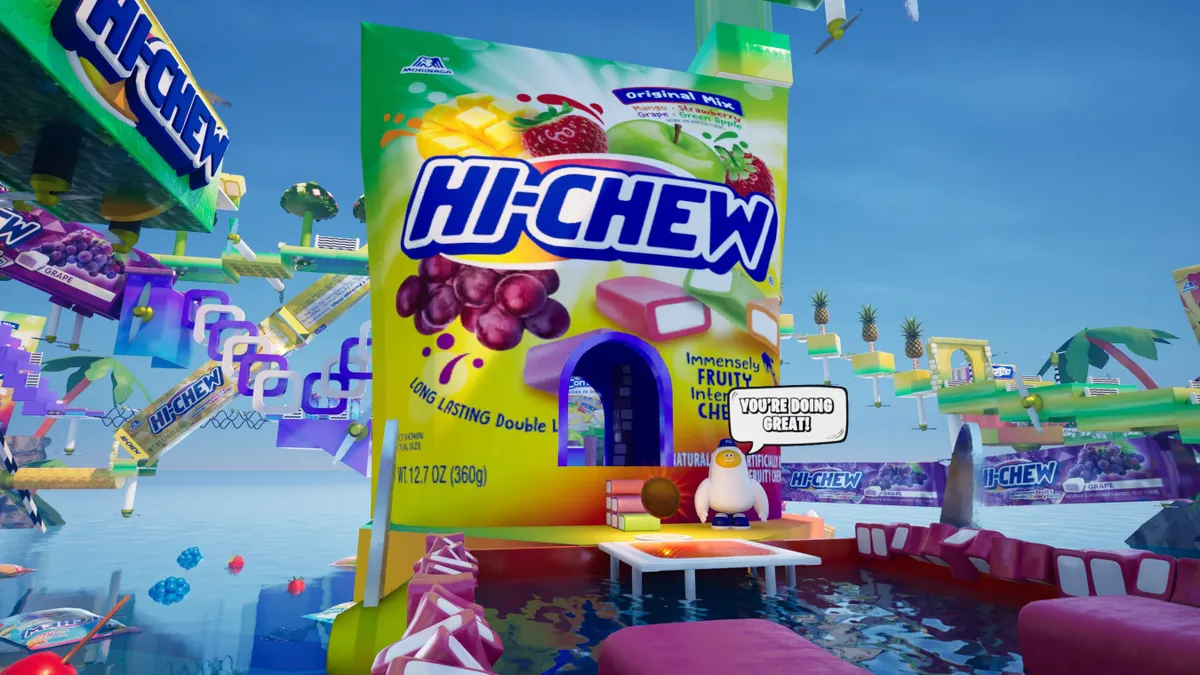
Hi-Chew’s evolving three-year partnership with the online video game Fortnite reflects the brand’s focus on media activations that feel genuine and unobtrusive. What began as a sponsorship in the first year expanded into a customized Fortnite game in the second year. In 2025, Hi-Chew sponsored a creator competition on the platform, giving players the opportunity to create their own Hi-Chew x Fortnite-branded experiences. Three of those mapmakers’ creations will be playable on Fortnite indefinitely.
“Throughout each activation, we are observing and collecting more user insights and consumer data,” Hsu said. “We use that information to tweak our approach and our role as a brand in the Fortnite game from year to year.”
Staying ahead
The brand also stages robust in-person events, which are tailored to attract members of its Chew Crew rewards program. Hi-Chew launched a direct-to-consumer e-commerce platform in early 2024.
In March, the brand set up an installation at Miami International Airport to introduce its Hi-Chew Getaway Mix. Over 10 days, more than 36,000 people visited the pop-up, which included sampling buckets; meet and greets with brand mascot Chewbie; a hot-air balloon photo op; and giveaways. The brand also distributed 48,000 product samples.
During Halloween, the brand drew more than 2,500 visitors to its Hi-Chew House of Mystery pop-up at the Irvine Spectrum Center in California. The installation was a playful haunted house that featured four flavor-themed rooms with puzzles and challenges, limited giveaways and, of course, candy sampling. In-person activations provide important opportunities to learn valuable insights, Hsu said.
“A lot of times when we have these in-person activations, we have a chance to interact with the consumer firsthand and get to know what they think about the brand, how they like the brand,” she said.
For both its digital and IRL activations, the guiding principle is to engage with its community in ways that are natural, organic and authentic. The Miami International Airport activation, for example, took place around spring break, when Miami is a popular destination for both families with teens and Gen Z students.
“We want to be able to meet the community organically and authentically at a place they are already planning to go,” Hsu said. “Rather than, like, popping up out of nowhere.”
In the new year, the brand plans to continue to heavily target Gen Z, while also turning its attention to Gen Alpha. That may involve looking at different gaming platforms and other areas where the upcoming generation congregates.
“We want to be ahead of the game, like we did for Gen Z,” Hsu said. “There’s still a lot for us to learn at the moment.”