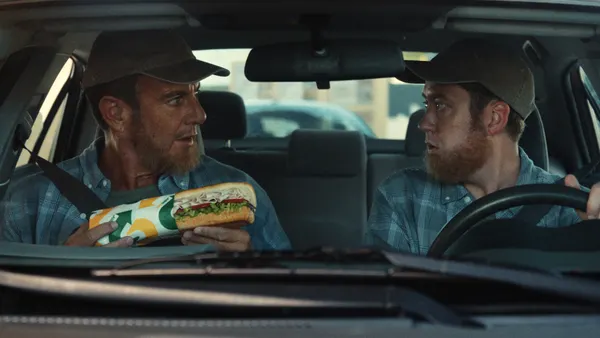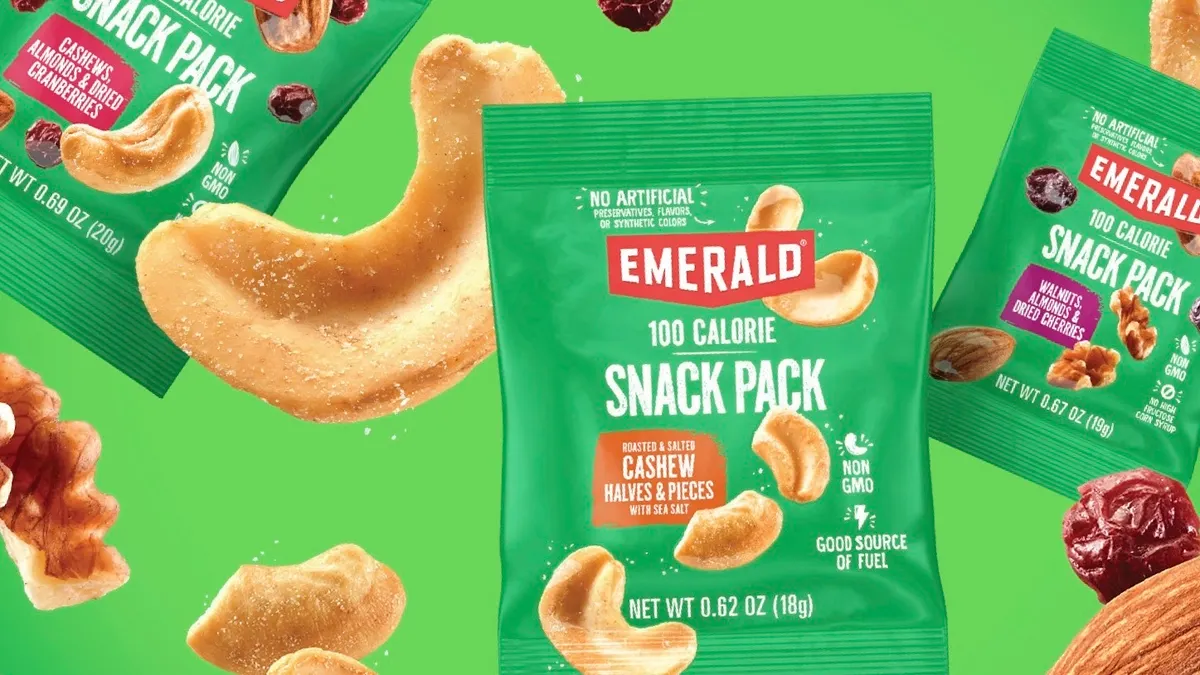
Last year, Emerald Nuts launched its first ad campaign in years that included a 30-second national TV ad filmed at a baseball stadium in Texas. A pair of Western-clad vocalists sang “Take Me Out to the Ball Game” during the seventh inning stretch. The singer eating Emerald Nuts got the song right, while the other, eating generic nuts, sang nonsensical lyrics to a confused crowd.
The ad compared the “nonsense in life” to the nonsense in the salty nuts category, and that “Emerald was coming in over the top of that,” said Dan Eisenberg, CMO at Blue Chip, a Chicago-based independent brand commerce agency.
Emerald is among the packaged goods challenger brands that Blue Chip has collaborated with over the years. These are mid-market and smaller brands with limited marketing budgets, but that have to compete against large corporate-owned or established brands with deeper pockets.
For challenger brands especially, it's crucial that the precious money spent on marketing builds awareness in a way that differentiates a brand from its competitors, while using research and data to zero in on the specific markets and retailers that are a strategic fit. Every marketing dollar spent needs to do “double duty” — building up the brand and driving the sale at the same time, said Eisenberg.
Challenger brands are inherently newer to the marketplace so it’s important that they build awareness, Eisenberg explained. But they have to make sure that awareness building and storytelling is connected to conversion, retail media, trade marketing and shopper marketing.
“Challenger brands specifically cannot afford to have separate branded performance strategies. There's way too much at stake,” he said.
A ‘Nonsense’ sales story
Emerald, which competes with Planters and Diamond, was purchased by Campbell Soup in 2018 — part of a $4.9 billion deal to acquire salty snack maker Snyder’s-Lance — before being sold off in 2023 to private label CPG manufacturer Flagstone Foods.
The brand was “kind of languishing” at Campbell, but essentially relaunched to the marketplace after being sold to Flagstone, said Eisenberg. That’s when Blue Chip was hired to lead Emerald’s brand, media, retail and marketing work.
Blue Chip conducted an assessment of the salty nuts category and found its competitors were selling low-quality products with a lot of fillers or “junk,” per Eisenberg. Emerald set about trying to tap into that white space by investing in new production capabilities and promising high-quality nuts and flavor.
This was the message that became the center of “Nonsense,” the brand’s first consumer campaign in years and which poked fun at competitors in the category.
“It wasn't just humor for humor's sake, it was humor with a real strategic reason and a clear point of difference in the category,” Eisenberg said.
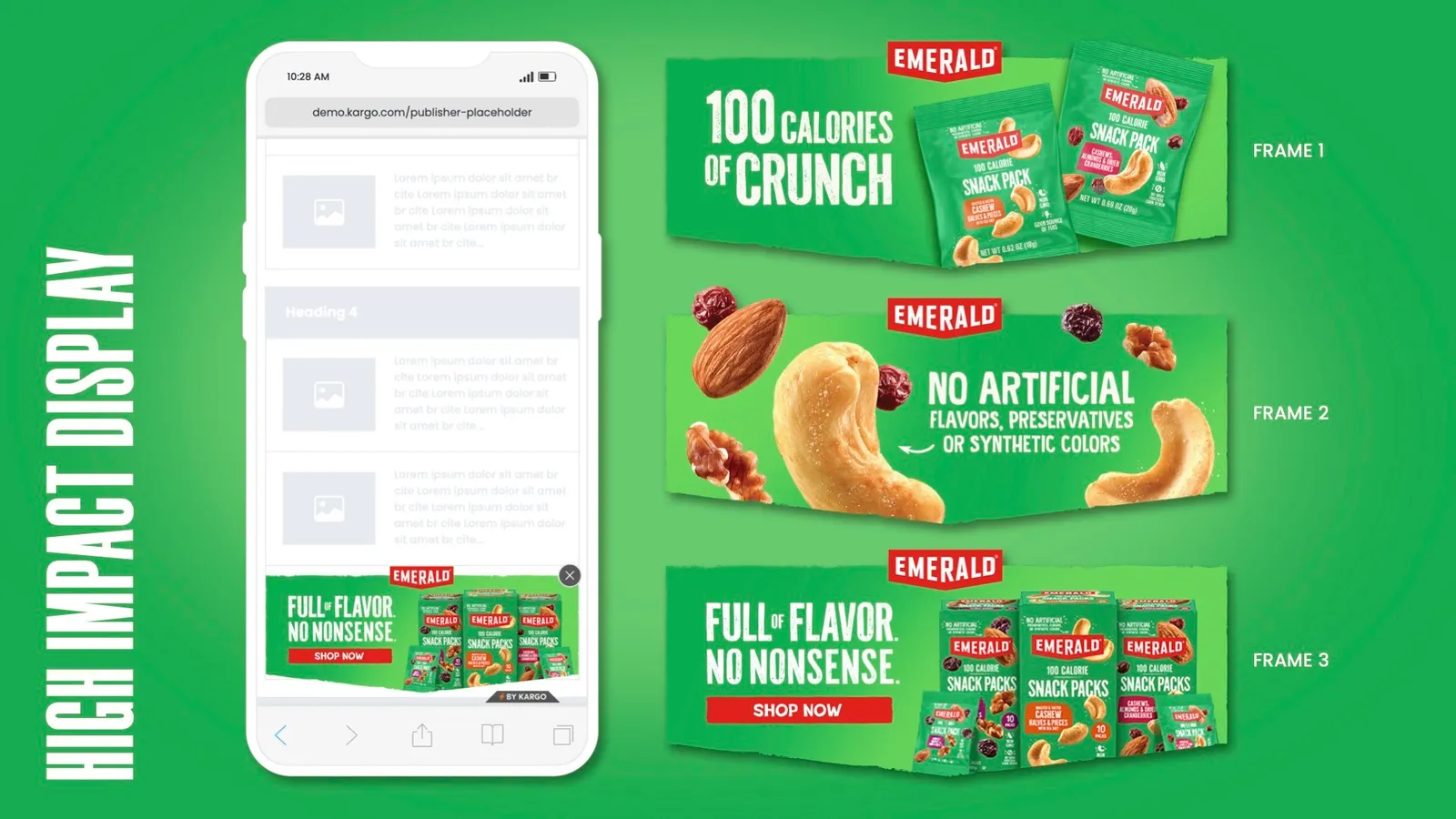
The media strategy included paid social media, such as TikTok and retail media for key retailers such as Walmart, Kroger and Publix, according to information shared by the company in an email. The effort ultimately connected with younger audiences — driving engagement among millennial shoppers by 11% and boosting new-to-brand purchases by 30%, the company stated.
It also gave Emerald’s sales team a new sales story that they approached retailers with — allowing them to rebuild the brand’s retailer relationships that had languished under Campbell, said Eisenberg.
Growing household penetration
Portland, Oregon-based Bob’s Red Mill, which launched a new brand look this year, has evolved into a national better-for-you food brand whose products compete with large, well-established players including Quaker Oats, a PepsiCo subsidiary, in the oatmeal space, and other challenger brands, such as King Arthur Baking in the flour space.
Blue Chip took on Bob’s integrated media and shopper marketing work and campaigns five years ago — working alongside the company’s marketing, sales and company leadership teams, said Eisenberg.
That led to an ad campaign that included its “Start with the Best Oats” tagline and was featured in digital and social media, through influencers, and in shopper marketing.
Blue Chip consolidated Bob’s media and shopper marketing investments into a cohesive strategy and launched full-funnel campaigns, said Eisenberg.
Bob’s had previously placed a larger emphasis on lower funnel, Eisenberg said. But, with its products now available in the Midwest, Mid-Atlantic, and Southeast of the U.S., it needed to reach new households, he said.
Blue Chip’s proprietary tool called Market Match, allowed the firm to algorithmically score the markets and designated market areas, where Bob’s they had distribution, and further prioritize where to invest its limited marketing dollars, Eisenberg said. The firm used data to analyze growth and secondary markets — figuring out where consumer look-alike audiences were deepest, where the distribution was going to be strongest, and where they were, or were not, seeing competitive activity, he said.
The campaign was also grounded in real research and data that showed the brand offered a superior experience, said Eisenberg.
The campaign helped Bob’s achieve significant growth in household penetration and dollar sales over the past five years, said Eisenberg. That includes a record-breaking Q4 in 2025 in which the brand saw its first million-dollar week at Walmart,according to information shared by the company in an email.
“The business has been very strong and a big part of that has been growing household penetration,” said Eisenberg.
“Fewer, bigger, better”
Challenger brands such as Bob’s Red Mill “don’t have the luxury of being everything to everyone,” said Eisenberg. But that constraint can also play to the challenger brand’s advantage, since the mindset can lead to strategic focus.
Blue Chip advises its clients to follow an approach of: “Fewer, bigger, better.” The firm’s clients make disciplined and precise choices around their consumer audience, their markets and the designated market areas where they are directing their media spend, he said. They also make decisions around the types of media channels they want to be in and retailers they want to support, he said.
“We're really focusing on high impact opportunities,” said Eisenberg.
Correction: A previous version of this article related a quote from Blue Chip's executive to the wrong brand and got the order of words incorrect in another quote. The article has been updated to address these issues.