
Creative production is getting faster, but that does not necessarily mean your creative operation is.
AI can generate concepts in seconds, turn one design into dozens of variations, and compress work that once took days into hours.
After shipping more than 25 million assets with Rocketium AI Studio, however, we have seen the time move elsewhere.
The brief still has to give production enough information to start. Review still has to decide what is worth shipping. And every asset still has to meet the brand, legal, and retailer requirements attached to it.
A faster build does not fix a slow brief
You have probably seen the request that looks simple until somebody tries to execute it. The asset itself may take 15 minutes to produce, but the team first needs to confirm the audience, retailer, approved claim, or CTA. One unanswered question leads to another, and a large part of the project gets spent figuring out what the team was supposed to make.
When we analyzed hundreds of creative briefs, the same problems kept appearing. Some were missing important information. We call them the 6 flavors of a bad brief:
- The Swiss Cheese: looks complete until you try to execute it.
- The Rorschach: everyone reads it differently.
- The Wallpaper: technically complete, but generic.
- The Rerun: last quarter's brief with new dates.
- The Novel: 40 slides nobody finishes.
- The Sure Thing: beautifully written, confidently executed, but built on the wrong premise.
Rocketium's creative operations data shows how much time can disappear around the work.
In one example, a 10-day creative cycle included only about six hours of actual creative work, with the rest going into waiting, clarification, and review.
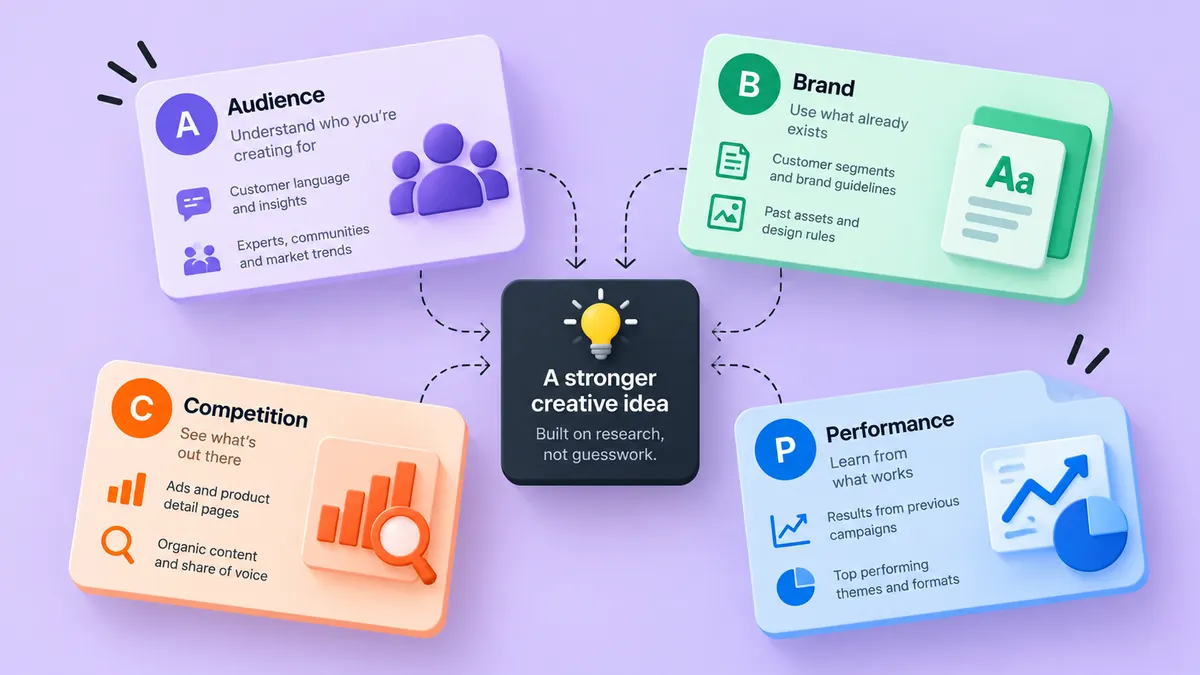
A good brief gets the important questions settled early. Rocketium's ABCP framework adds the research around it.
- Audience looks at customer language, experts, and trends.
- Brand looks at customer segments, guidelines, past assets, and design rules.
- Competition studies ads, product detail pages, and organic content.
- Performance looks at what previous creative actually did. Those inputs shape the core idea before production starts.
AI can gather and organize much of that context. The campaign owner still has to decide the objective and make the business tradeoffs behind it.
More AI changes what people should review
The problem usually is deciding which assets are good enough to ship without asking senior reviewers to inspect every detail in every version.
A lot of review time gets lost in familiar ways. Feedback like “make it pop” identifies a problem without explaining it.
A reviewer may correct logo placement before noticing that the asset does not follow the brief. Another stakeholder may arrive late and reopen the direction after several rounds.
Rocketium's AI design crit turns those patterns into specific checks.It looks at brief adherence, brand, visual hierarchy, craft, taste, AI fingerprints, and final quality.
One simple example is the squint test. Reduce the asset until the copy is unreadable and see what remains. Where does the eye go first? Is the product still clear? Does the composition still hold together?
AI can repeat checks like these across large volumes and catch rule-based issues before a person sees the work.
What it cannot settle is whether the creative is distinctive enough, right for the brand, or the right idea for this campaign. Those decisions still belong to people with context and accountability.
Compliance has to move earlier too
One campaign can carry different rules for logo position, typography, safe zones, claims, file specifications, and retailer requirements across markets and formats.
Rocketium's research on brand compliance shows why manual review becomes difficult at scale.
Human reviewers can typically check 50 to 100 creatives a day at about 85% accuracy under time pressure. Rocketium's automated compliance system processes more than 10,000 creatives a day at over 90% accuracy by checking defined rules before human review.
NIVEA saw the effect across more than 20 retail platforms. After retailer guidelines and automated quality checks were built into its workflow, platform rejections fell by 98%.
Find compliance problems while the asset is still being made, not after everyone thinks it is finished.
After 25 million-plus assets, that is the pattern we keep coming back to. Faster generation helps, but creative production only moves as fast as the research, decisions, checks, and approvals around it.