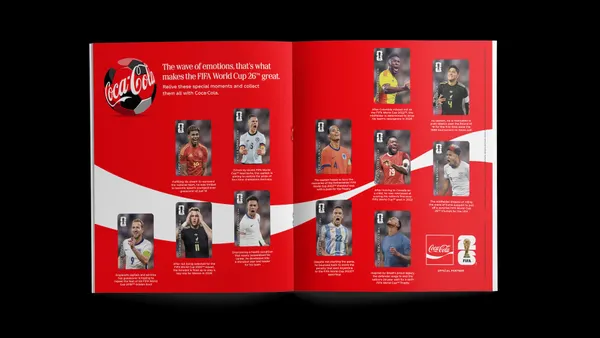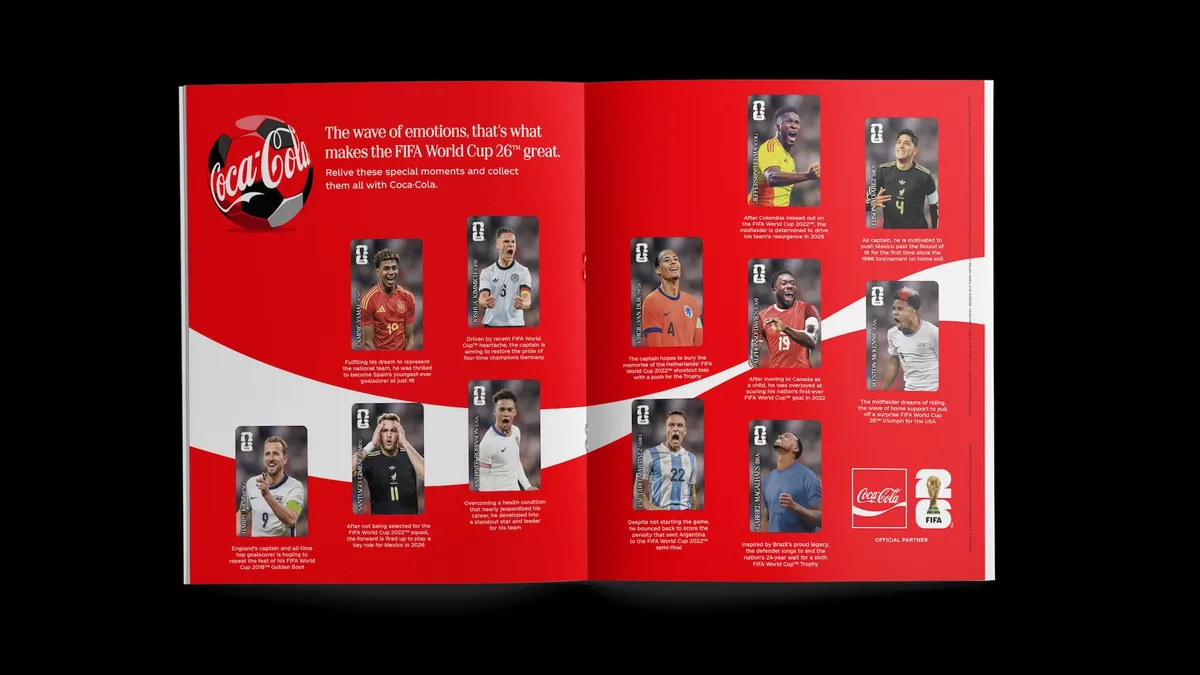
With the World Cup less than three months away, Coca-Cola North America is going into greater detail around its partnership with sports memorabilia firm Panini America, per information shared with Marketing Dive. The brand will include the FIFA partner’s collectible stickers directly behind the labels on 20-ounce Coke and Coke Zero Sugar bottles.
Coke’s collaboration with Panini ties the brand to a long-running tradition in soccer, first introduced during the 1970 World Cup, that sees fans fill booklets with stickers capturing the players, teams and iconography of each tournament. While part of a ritual for soccer fans, the stickers also represent an opportunity for newer fans of the sport to forge personal connections with players, explained Shakir Moin, chief marketing officer of Coca-Cola North America.
“As we have been working on building a soccer plan for FIFA for 2026, one of the objectives was how to build this game in the U.S., not only for FIFA World Cup, but hopefully for all the generations to come,” Moin said. “It's not only about an ad campaign. What is that ritualization that’s going to happen throughout?”
Consumers can collect the stickers by purchasing participating Coke products at select locations beginning April 20. The stickers will have a dedicated page within the official Panini FIFA World Cup 2026 sticker album. The brand’s collection features 12 soccer stars from around the world, including England’s Harry Kane, Germany’s Joshua Kimmich and Spain’s Lamine Yamal, and speaks to the marketer’s mantra that “consumption is connection.”
“If someone drinks our products — a Coca-Cola, Coca-Cola Zero, BodyArmor, Powerade — that will create a connection and love and empathy for the brand,” Moin said. “Connection doesn’t always lead to consumption — there are too many barriers — but a consumption is a sure thing, so we’re trying to create more of our programs that excite and invite our consumers to buy our products, enjoy them and get value out of it.”
Hyper-personalization in action
Coke’s collaboration with Panini is part of its global campaign around the World Cup, for which it is the official soft drink sponsor. The effort, which was unveiled in January, spans 180 markets and includes digital and in-person experiences, including a trophy tour. It’s an occasion for marketer to scale its opportunities globally while also hyper-personalizing engagement with consumers at the local level, an approach Moin describes as “de-averaging at scale.”
“The fundamental notion behind de-averaging at scale is that communicating a singular idea to all 330 million Americans is a very broad average,” Moin said. “In today’s world, the ability to understand big consumer pockets and exactly the words that you use to separate the fans from the fanatic from the casual fans is something that we can do.”
Coke has the ability to use passion-point data at the zip code level, determining which consumer cohorts prefer soccer versus, say, basketball, and which consumers are die-hard or emerging soccer fans. This data allows the brand to communicate with different fans in different ways. For example, Coke is teaming with actor Cristo Fernández, portraying his “Ted Lasso” character Dani Rojas — and his “fútbol is life!” catchphrase — to explain the ins and outs of the sport to newcomers.
“We are choosing by city, by connection point, our messaging... It’s already starting to be in outdoor differentially, depending on that particular location, that moment, versus the same message being plastered all over,” Moin said. “This is probably our biggest initiative on de-averaging at scale, which we have been piloting for some time, and now we’re going to get into a full-scale execution.”
AI implementation continues
Coke during its CAGNY presentation in February teased an activation featuring legendary soccer manager José Mourinho that will deliver artificial intelligence-powered content daily. While that part of the World Cup campaign is still in the final stages of completion, the soft drink brand continues to use AI in different ways — not just in its much-discussed holiday campaigns.
“We are using AI on predictive decision-making and predictive learning. The data was always there. The problem was how to mine that data and then pull an insight out of it to make sure that we can do something with that,” Moin said.
For example, Coke rewrote its entire brand book and fed it into AI — a “small language model” rather than a large language model — to help its marketers better craft communications that are in tune with the tonality of the brand, according to Moin.
“We always believe that even in this world of AI, humans are going to be in the middle,” the executive said. “We have some brilliant creative teams that are in-house. They use this as an input that is making their job a lot more easier. So the AI usage is now expanding.”