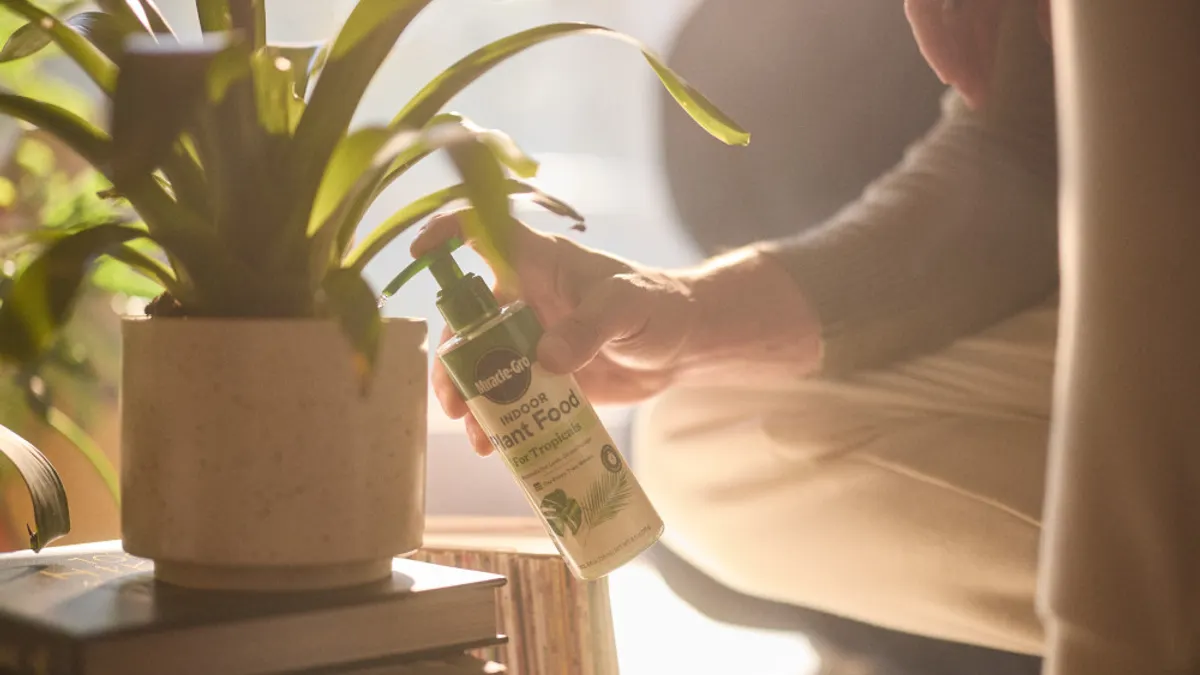
Spring is here, and for the more than half of U.S. households that partake in gardening, it’s the time to flex green thumbs and put plants in pots and plots. But like many other activities, gardening has been altered by consumer behavior changes over the last five to ten years.
“After COVID and a global pandemic, and the way Gen Z and millennials have reshaped everything, our go-to-market business has evolved,” said John Sass, senior vice president, chief creative officer and general manager at the Scotts Miracle-Gro Company. “Gardening and growing is not just a spring activity, it's not just for weekend warriors… it’s a 12-month business.”
To meet that changed consumer, Scotts Miracle-Gro is working to adapt its marketing to engage newer gardening enthusiasts and deepen their relationships with the company’s brands, which includes its namesake brands alongside Ortho, Tomcat and others. To that end, the company will increase investment in its brands with $25 million focused on media, digital and R&D, according to a January earnings call.
“If you look at how we think and talk and advertise to consumers, we absolutely have [worked] to become more of a 365-day, always-on partner,” said Sass. “It’s changed all aspects of our marketing.”
Scotts Miracle-Gro saw U.S. consumer net sales decrease 4% to $328.5 million during its fiscal Q1 2026, which beat analyst estimates. The company estimated U.S. consumer net sales will see low single-digit growth this year. That growth is roughly in line for the overall demand for packaged lawn and garden consumables in the U.S. The segment is forecast to rise 3.2% annually to $13.6 billion in 2029 as millennial and Gen Z gardeners enter the market, per a Freedonia Group report.
Sass has spent more than 20 years at Scotts Miracle-Gro and was promoted to his current role just over a year ago. The executive spoke with Marketing Dive about how the company has worked to evolve its legacy brands, how it is approaching AI and more.
The following interview has been edited for clarity and brevity.
MARKETING DIVE: How has Scotts Miracle-Gro’s business changed in recent years?
JOHN SASS: Everything — our product, our messaging, our advertising — has evolved. Previously, products were designed for weekend warriors: big sizes, large bags, load up your trunk of your car. Packages had to evolve as consumers are buying off of Instagram and TikTok Shop. We have to have more e-commerce-friendly packaging that doesn't require multiple bags inside of boxes.
I think if you went back 10 or 15 years ago, and probably even earlier than that, our advertising and messaging was very much product-centric. Now, we've realized there's a time and place for all that messaging, but we can leverage bigger partnerships — ESPN Opening Day baseball, March Madness media buys — where you have all of America with eyeballs on our category. We have the opportunity to inspire people to want to put their hands in dirt or to get outside and spend time in the backyard. That's how we're going to grow category participation.
Newer consumers in the category absolutely need education, but we leverage our messaging much more now to be inspirational, to talk about getting into the category. That's where we have influencers and a lot of other people that are helping deliver that message. So it's not just that 30-second TV commercial trying to tell you everything.
How are you using and measuring influencer marketing?
It's hard to inspire people through 30-second TV commercials. They have a place, obviously, but what we're seeing is that connection and that trust factor that people are looking for online, a lot of it comes from their social communities and their networks, and that's where influencers play a huge role.
There’s none bigger than Martha Stewart, and she's our chief gardening officer and a fantastic ambassador for our brand. But there are also thousands of micro- and nano-influencers that are helping people learn how to take care of their indoor house plants, as well.
There's a lot to be said for affiliate programs. One way to measure how convincing the influencers are is for folks to click a button and get the code. That's one effective way to do it. We also still do all the traditional media mix modeling testing, so we are able to see the shift away from bigger format, traditional linear TV into more digital and social advertising, and then into LLMs. We have all these brands that we can learn from, so it's a constant test-and-learn for us.
You mentioned LLMs. Where does AI fit in the picture for you?
First off, it's fantastic that education is at everybody's fingertips. You'll get good, generic advice [from AI]. Here's the Scott's Miracle-Gro difference, though: We have 158 years of applying our specific knowledge. We know what grows in Miami versus Boston versus Denver. That's the nuance that we bring.
As part of our ecosystem that we've been building to help next gen consumers, we have a proprietary model that takes our knowledge base coupled with what consumers are looking for, and that's the trust that we believe is a difference maker.
We're working to make sure that all the knowledge that we know exists within our company, that we can give that access on a one-to-one basis to consumers, and that's where the agentic AI and the search functions on our website are going to be different from others.
Data starts to make your marketing mix shift from speaking at consumers to engaging in a relationship, in a conversation. In retail media, how do you get closer to the actual consumer, or at least your target audience, whether that's somebody in the category or somebody you're trying to get into the category? The challenge with one-to-one marketing is, how do you scale it? Now with agentic AI and all the things that we have from a technology perspective, you now have that ability.
Scotts Miracle-Gro recently secured the naming rights to the soccer stadium where the Columbus Crew play. What role does sports marketing play in your mix?
We want to connect authentically to where consumers and passion and interests are, and there's no bigger passion points right now in the country than sports. We're very fortunate that our category does coincide so beautifully with a lot of the sports that people want to go to.
If you want to bring new people into the category, the first time they have an engagement with our brand, we don't want it to be with a product and reasons-to-believe: We want it to be with a brand at a high level. Playing on real natural grass is a sweet spot for the Scotts brands.
We still show up very highly in a lot of sports programming. Especially during the start of spring, there's a great run between March Madness, the Masters, the opening day of baseball. NBA and NHL playoffs are not on grass, but it's still tune-in worthy.
Whether it's eyeballs on TV or authentically tying to the partnerships, I think we've really found a sweet spot with our brand, because at the end of the day, we want to be super authentic and we know that time spent outside, time connecting with green space is really powerful for mind, mental wellness, physical activity — everything.