Dr. Squatch is going back to basics for its latest campaign and first large-scale marketing push behind its line of deodorant products, per details shared with Marketing Dive. The Unilever-owned men’s grooming brand, long known for its wry, raunchy marketing voice, has teamed with actor Megan Fox for a series of ads that mix value propositions with slapstick and sexual innuendo.
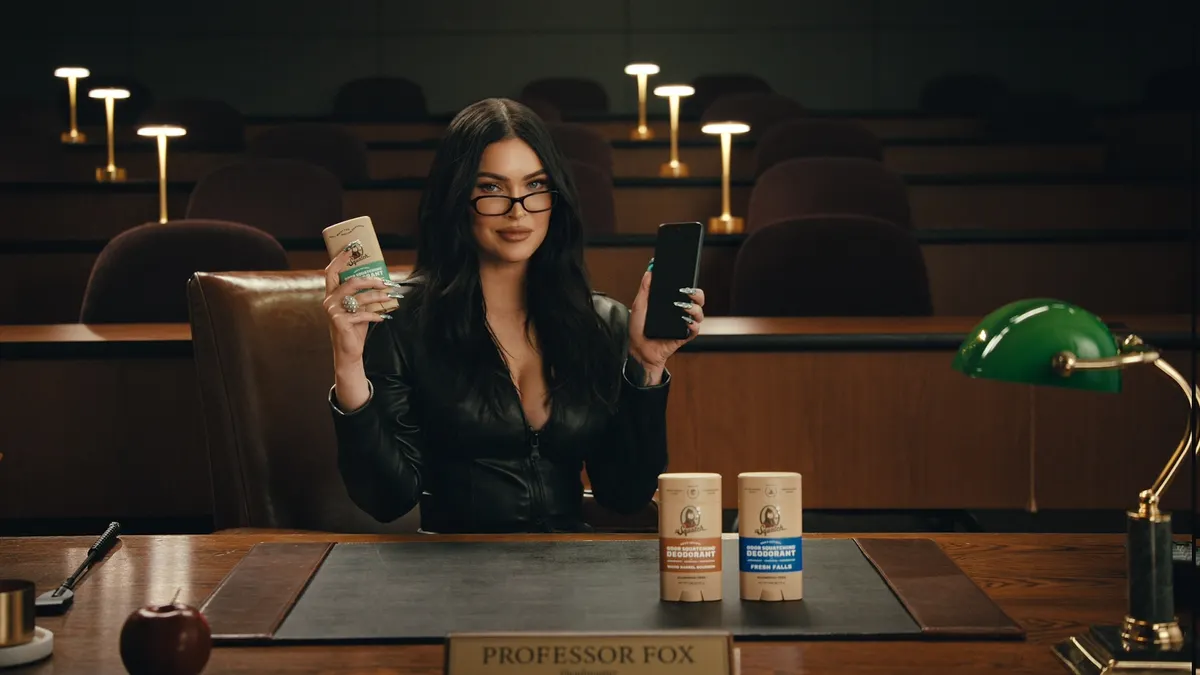
In the campaign, the “Transformers” and “Jennifer’s Body” star portrays Professor Fox, the head of Dr. Squatch's fictional Foundation for Odor Excellence. Across six ads, Fox introduces the brand’s two new deodorant products and describes herself as “your crush since puberty.” All the spots include the tagline “Let Your Stick Do The Talking.”
“The reality is, when you're not a mega brand with hundreds of millions to spend in marketing, you have to take a little bit of risk to get things that really stand out and cut through, because you don't have the ability to just spend huge sums of money to create that repetition that burns the message into the the audience base over time,” said John Ludeke, who was promoted to chief brand officer at Dr. Squatch in February.
The ads, a mix of 30- and 60-second spots, will roll out across owned channels, including organic and paid social. Fox, often wielding a riding crop, is put in various school and laboratory settings, including a locker room, to deliver lines like, “Men can't stop sending me their stick pics.”
At several points, the ads nod to Procter & Gamble-owned competitor Old Spice, in the form of a generic, red-and-white deodorant stick and dialogue about an “old and spicy deodorant spray” that is an example of something that should change after middle school. Fellow Unilever brand Axe has used a similarly scholarly framing device to take on young men’s grooming habits. The ads represent a different tack for Dr. Squatch, which normally advertises more ephemeral products like soap and body wash.
“Deodorant, for a lot of men, is higher consequence [than soap]. If it doesn't work, it'll lead to embarrassment. It'll lead to pit stains on my shirt. It'll lead to problems,” Ludeke said. “Guys tend to be pretty loyal toward fragrance profiles that they like, because deodorant fragrance is certainly something that's going to be on you for for the full day.”
Along with positioning Dr. Squatch as a brand for modern men with evolved routines around skincare and the gym, the ads contrast the natural ingredients of the brand’s deodorants with the synthetic ingredients — including the butane used in some aerosol sprays — of competitors.
“We wanted to do a larger-scale campaign to help educate guys on the different products that are now available and the different alternatives that are out there in the natural, better-for-you space,” Ludeke said. “Hopefully, we can convert more of them from more conventional products over toward the better-for-you category.”
The traditional playbook doesn’t work
Dr. Squatch’s marketing has often used humor to educate about men’s health and well-being. In the same way, the brand has previously utilized a star with sex symbol status to deliver that message. The brand in 2024 memorably cast Sydney Sweeney as a “Body Wash Genie” in ads that predated her appearance in a controversial American Eagle campaign by almost a year.
“We usually try to take cultural contracts and either embellish them or flip them on their head a little bit to drive interest and engagement,” Ludeke said. “Megan is an icon, but a lot of times, it's guys who are looking at her, so we really wanted to take Megan and to put her in a position of power.”
It remains to be seen if consumers will understand the knowing nod to traditional gender dynamics in the campaign, or simply be caught by Fox’s suggestive dialogue and costuming. But the campaign continues Dr. Squatch’s winning formula of triangulating humor, education and entertainment to break through in culture. Likewise, the campaign’s six-part creative speaks to changes in consumer behavior around ads.
“The traditional playbook just doesn't work that well anymore. People get creative fatigue really quickly, and people get tired of things really quickly,” Ludeke explained. “Brands are optimizing with the assumption that their creative isn't really going to be something people want to watch, so the guidelines are usually you need to have your logo or your product in the first two seconds. Well, that's as long as it takes for someone to realize they're watching an ad, and then after that, they just don't really care.”
Instead, Dr. Squatch looks to create a variety of content with different perspectives and messaging that ladders up to an overarching campaign message. The campaign also includes material for social, out-of-home and e-commerce channels.
“The goal is not to have a great launch, and then people get tired of it,” Ludeke said. “The goal is to have different touch points throughout the entire campaign, so there's always something new for people to experience, so it becomes more of a world-build versus a standard advertising approach.”