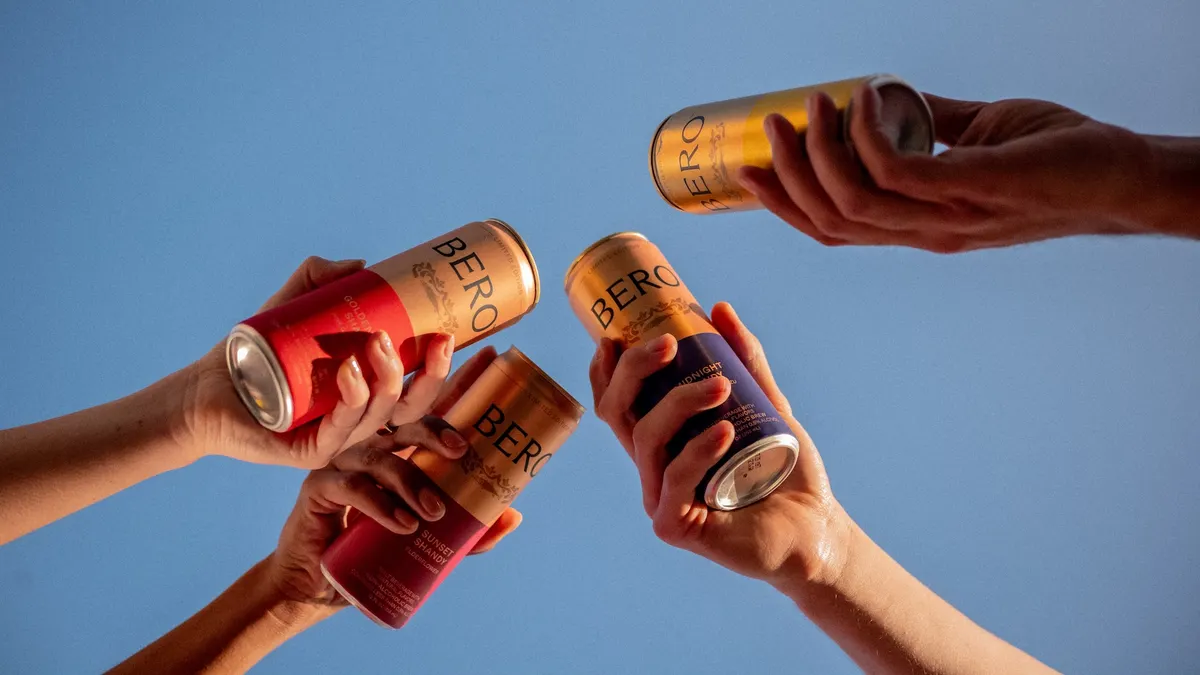
Nonalcoholic beer brand Bero launched in late 2024 with a major co-founder: actor Tom Holland, best known as the most recent cinematic incarnation of Spider-Man. In a growing nonalcoholic beer market, Bero looks to stand out not just due to its celebrity co-founder and his sobriety journey, but as a brew — in styles like European pils, hazy IPA and wheat — for a balanced lifestyle.
After debuting on Target shelves in 2025, Bero — which rhymes with “hero” — reported nearly $10 million in sales in its first year. The company projects revenue to more than double this year as distribution and sales expand. The larger nonalcoholic beer market is expected to grow from $23.84 billion in 2025 to more than $38 billion in 2030, according to The Business Research Company.
To accelerate growth, Bero’s marketing has relied on partnerships with brands that speak to the active, aspirational lifestyle of which it looks to be a part. Bero this year partnered with fitness studio chain Barry’s. The team-up comes to life today, July 2, with the announcement of a limited-time shake inspired by Bero’s shandy line that will be available exclusively at Barry’s Fuel Bars in the U.S. and UK.
Bero’s shandy line — created with Holland’s partner Zendaya in mind — launched last month at Target and rolled out on July 1 to retailers including Kroger, Publix, Erewhon and Amazon. Holland also appeared in a recent Chase Sapphire Reserve for Business campaign, offering a glimpse of how the card helps in his business pursuits.
Marketing Dive spoke with Jackie Widmann, the senior vice president of marketing at Bero, about the brand’s strategy, creative tack and approach to balancing B2C and B2B marketing. The executive was the fifth full-time employee at Bero and leads global marketing efforts, communications strategy and commercial go-to-market for the brand.
The following interview has been edited for clarity and brevity.
MARKETING DIVE: How did Bero’s relationship with Chase begin and evolve?
JACKIE WIDMANN: We had approached them initially about getting Bero in the Chase Sapphire airport lounges across the country, which felt like a no-brainer way into working together. Our consumer is certainly someone who's [an] on-the-go, working professional, hitting the airport lounge, maybe before they go on a business trip or travel for fun.
We were able to build that into something a little bigger. We had two different events that Chase sponsored over the course of Wimbledon week last year in London. The first was a founder conversation between Tom and our co-founder, John [Herman], about why this journey started, and where the brand idea came from. The second was a hospitality introduction where Chase helped us get in front of a lot of different really high-profile hotel and restaurant clients that all are part of the Chase ecosystem. That led to some cool opportunities for distribution.
How did Tom and Bero end up in the Reserve for Business card campaign?
They had launched the card without any recognizable face as the ambassador for the card and the overall marketing plan. It felt like a really authentic way for us to build around this journey of building a business from the ground up, feature Tom as a founder and showcase the way that his idea to create something for his younger self could really grow into something so much bigger, and obviously highlight the world of NA beer and our brand in the process.
We were able to work closely with Chase, which is a massive, globally recognized company, on a campaign that we certainly would not have been able to do at this stage in our company's growth. Being a year and a half in, and to have an omni-channel campaign supported by a partner like Chase that is running across TV, streaming, airports, out of home, radio and social is pretty unbelievable.
This is just phase one. The year ahead will be focused on planning and how we continue to tell the story and showcase Tom as a founder, beyond just why he started this, really digging into some of the challenges that a founder might face as we continue to evolve the creative over the next year.
Regarding those hospitality meetings, how does the brand market to consumers and the industry simultaneously?
Ultimately, it's the same idea, but messaged a little bit differently, depending on who the audience is. In the B2B capacity, with distributors, retailers and on-premise partners, we're telling the entrepreneurial story of why Tom set out to do this and why Bero exists, why we believe we're differentiated. But we're telling that story to people who are doing the same thing in their own right, whether it's building a hospitality business, launching new hotels or keeping your bar or restaurant in the mix in a crazy industry where new places are opening all the time.
On the B2C side, you look at the competitive landscape in beverage at large, or even greater CPG, and there's an overwhelming number of new products launching. For us, it was more the emotional side of the storytelling that I think we focused on with consumers.
We have Tom's story of his own journey with sobriety that's been really powerful, but we're not creating a brand that has to be for the sober person. Where we've seen a lot of consumer resonance is around the folks who are just looking for some mindful indulgence and balance in their lives and want a brand that they feel represents them and the lifestyle that they want to live: a little bit aspirational, a little bit elevated, but certainly not preachy in any way about what they should or shouldn't be drinking. It's really around finding that balance and enforcing a bigger message around creating a lifestyle and a community that people hopefully want to be a part of.
How have you approached partnerships to drive growth?
Everything that we do touches a different pillar, where the partnerships that we're launching are meant to really tell a bigger story about how Bero can fit into people's lives, and show up authentically in moments where people are already gathering and connecting, traveling, recovering, celebrating and just wanting more options on the menu or the table in front of them.
The Padel Classic is certainly a more closed-door VIP event, but then we're also doing a lot of great partnerships on more of a local level, where there are local padel clubs and where Bero is now served across the country. We're trying to get the product in the hands of people that are seeing what we're doing online and want to be a part of it.
Barry’s is another great example. They are a brand that very much values high performance and social connection, bringing people together over this “work hard, play hard” mentality, and I think that one really aligns with Bero as well.
Aston Martin was another one. By becoming their official NA beer partner for the next few years, that’s about deep British roots, a commitment that we share with their team around high-quality craftsmanship, a desire for excellence and creating aspirational luxury.
How does marketing support the brand’s positioning around fitting into consumer lifestyles?
It's really about reframing the conversation around NA beer. Historically in the category, a lot of the creative and content that you'll see is defined by what is not in the product, and we really wanted to shift that focus to the things that you get, receive and feel when you choose Bero, embracing that fully by not having to sacrifice things like quality, taste and craftsmanship, but also reinforcing the idea and belief that NA beer should taste and feel exactly the way that you expect.
With our new shandy launch, we really tapped into the “100% Bero” message by leveraging this idea that the product is 70% lemonade, 30% Bero and 100% refreshing. It's a fun evolution of the way that Bero is giving consumers more occasions and ways to engage with our product. Maybe you're not an IPA lover, but you might love our shandy. We've been able to use this umbrella of “100% Bero” to appeal to some new consumers and find a way for people to take that, flip it on their own experience and speak to how Bero makes them feel, which is really the goal.