Campaign Trail is our analysis of some of the best new creative efforts from the marketing world. View past columns in the archives here.
In these polarized, fractious times, it’s tough for most people to find consensus on countless topics, let alone the interests that define them. While 83% of people believe they have good taste, less than a third agree on what good taste actually means, per a study spanning Asia, Europe and North America commissioned by beer brand 1664.
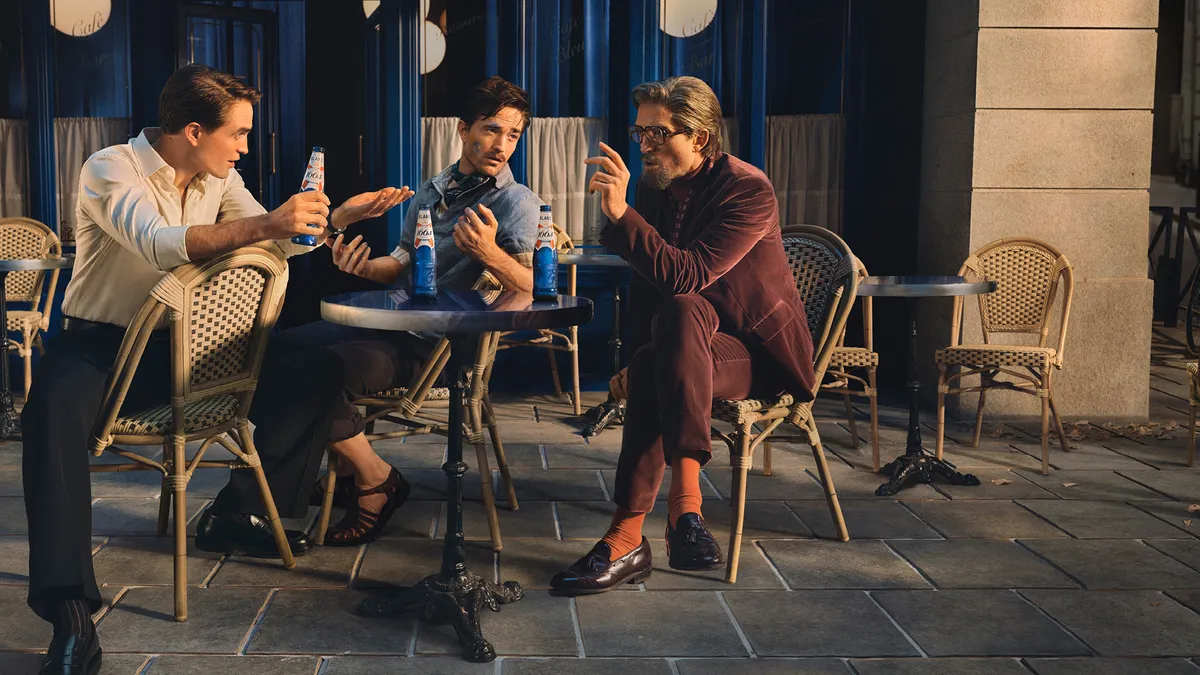
That insight is the central tenant of “A Question of Good Taste,” the new campaign from the Carlsberg Group brand formerly known as Kronenbourg 1664. The effort was created with London independent agency Fold7, “The Brutalist” director Brady Corbet and the brand’s global ambassador, actor Robert Pattinson.
In a 60-second hero, Pattinson plays several residents in a Parisian apartment building: a modern minimalist, an eccentric older man with a goatee and gaudy glasses, and a paint-splattered, avant-garde artist. The neighbors battle over music choices — piano playing, jazz records and electronic music CDs — and food orders, including an Instagram-ready burger, a baguette and a well-dressed oyster. They prefer different footwear and reading material, as well. The three agree on one thing, however: a cold, blue-glass bottle of 1664 Blanc. In a kicker, Pattinson also plays a long-haired, leather-clad rocker, also with 1664 in hand.
“Good taste is only your responsibility and it's your way of seeing things. Nobody can tell you if it's true or not. We thought this contrast and this tension was interesting to leverage,” said Laurent Cayet, vice president of creative and experience at Carlsberg Group. “The core campaign idea is about agreeing to disagree, was very interesting and very rich.”
The global brand platform and integrated campaign will run across TV, digital, social and out-of-home, with in-store work created by agency Live & Breathe and a social campaign by We Are Social. But even with Pattinson in tow, the agency and brand shied away from a traditional campaign built around a celebrity.
“Typically, when a brand has a famous person, all that you end up with in 99% of advertising is them generally being themselves,” said Fold7 Founder and Chief Creative Officer Ryan Newey. “You get a vibe from those celebrity-driven campaigns. They have a look and a style, but they don't have a great deal of substance.”
A detailed, practical production
For Fold7, the right vehicle for a discussion of taste was inspired by a classic film, Alfred Hitchcock’s 1954 “Rear Window” — a cinematic classic that shares a sense of class and style with 1664, Newey explained. The production landed on the dynamic of neighbors in conflict, but instead of two Pattinsons, as there was in last year’s “Mickey 17,” what if there were more?
Digging into the characters, Fold7 dove into the subjects that could communicate taste in a simple, visual way: clothes, food, music. It then built up the characters in collaboration with Pattinson and Corbet, who previously directed the actor in “The Childhood of a Leader,” determining if the chamelonic Pattinson could get a feel for the characters and find their motivations. But the characters had to serve the budget of both the production and the brand.
“We had some ideas for characters, but it just wouldn't have been possible to shoot it in the time frame, because you'd have spent all day in prosthetics, really doing your transformation,” Newey explained. “And then also, our client has paid millions of pounds for Robert, and if you augment him too far, you might not recognize him.”
To produce the ad, Corbet brought in the same composer and same director of photography that had worked with him on “The Brutalist.” The set was built practically, bringing a verisimilitude to the ad and helping to inform Pattinson’s performance.
“You can go through the windows of those sets and see [the characters’] apartments, so that the characterization of that guy is really brought to life in their lounge, the posters and books they read, and the level of detail there,” Newey said.
The depth of detail in the ad will also help 1664 extend the platform beyond just this launch. The brand didn’t want this to be a celebrity-driven spot that lasts for a few years and then loses the ambassador to another brand’s celebrity-driven spot. The effort can flex based on the arguments around taste on a market-by-market basis.
“It's not a one shot. It's supposed to be something that is to live for many, many years,” Cayet said. “That's what we liked about it from the beginning: It has this breadth, and it can be stretched quite a lot.”