Campaign Trail is our analysis of some of the best new creative efforts from the marketing world. View past columns in the archives here.
For decades, Skittles has relied on weird and wonderful ads to break through with audiences, encouraging consumers to “Taste the Rainbow” in spots that have featured a cursed co-worker, a battered piñata man, a prehensile beard and many more outsized scenarios.
That surreal tone — where humor is spiked with pain — returned this month in a series of ads in support of a new Skittles Gummies product. The spots are by TBWA\Chiat\Day, the agency that started the Mars brand down this path all those years ago. DDB also worked on the campaign in the years before the shop was absorbed into TBWA.
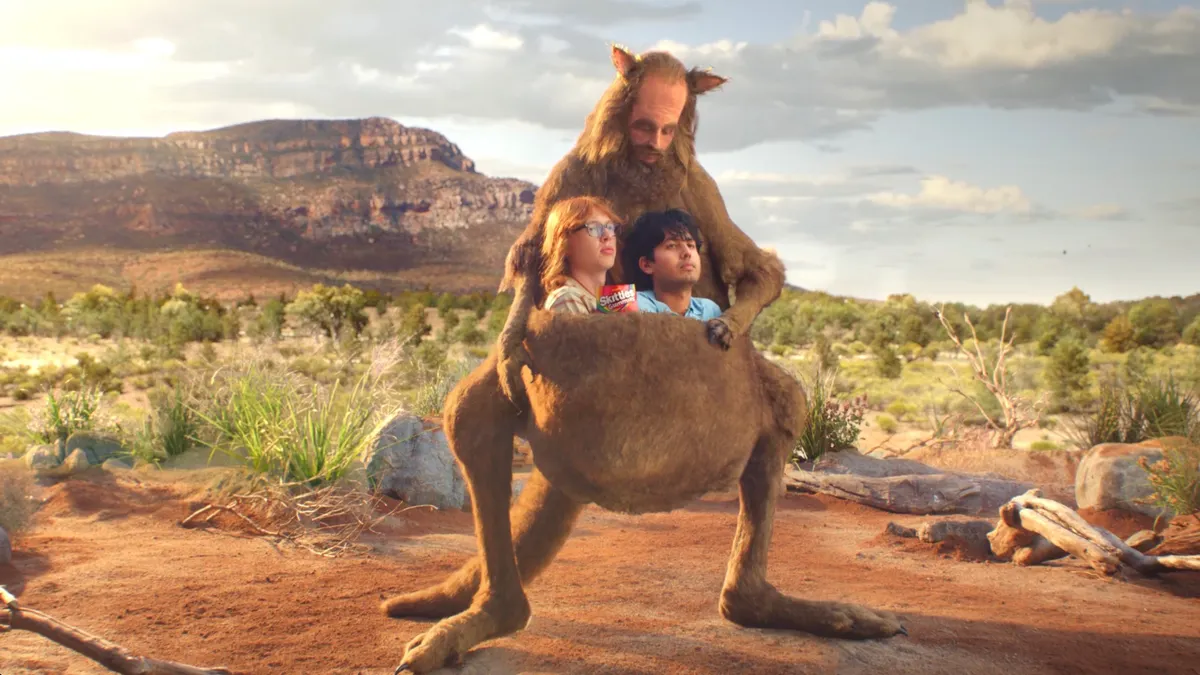
Meet the “Mangaroo,” a man-kangaroo hybrid who talks in a sing-song voice and feeds candy to his adult children, and “Balloon Dog,” a twisted party favor that scooches its butt on the carpet. Also in the mix is the “Jellyfish Massage,” which is exactly what it sounds like.
The 15-second spots, which rolled out recently across linear, connected TV, online video and social media, have together notched more than 5 million views on YouTube. For the creative, TBWA\Chiat\Day took an insight about Skittles Gummies being softer than other gummies to an extreme conclusion at “an uncomfortably soft level,” explained Brian Culp, group creative director at TBWA.
“We try to stay true to the original world building that Chiat/Day New York did back in the day…where you're basically trying to add a little bit of magic to a pretty mundane world, and everyone treats that magic like it's pretty normal. No one really acknowledges there's anything wrong about it, and then there's always a slight bit of tragedy where maybe the magic didn't end up panning out like someone in the spot would have hoped so,” Culp said.
To bring that magic to life in the new spot, the agency tapped director Carl Sundemo of Epoch Films, partially because he takes a practical approach to how he shoots. For example, the balloon dog and jellyfish arms were controlled by puppeteers who were digitally removed from the frame.
“You can very much feel it, even how the actors respond to things. You typically feel when things are practical, and it really adds this level of surrealness and ups the unsettling nature of some of these, which I think you would lack with CG and AI,” Culp said.
“The guy who was getting the massage in the jellyfish spot was genuinely uncomfortable when he got slapped by the puppet. There's just something about the realness of truly being slapped by a jellyfish that you can't fake,” added Katie Bero, group creative director at TBWA.
Candy sales are projected to reach $27.8 billion by 2030, per the National Confectioners Association, and Gen Z spending on candy increased 47% year-over-year in 2025. While the new ads are pitched at Gen Z, the creative process for Skittles’ ads hasn’t changed, even if the generational target has. Comedy — and tragedy — often play out the same way, no matter the age of the viewer.
“Gen Z is not the idea: They're the target. A lot of times people are starting with Gen Z as the idea. Skittles is the brand and Skittles is the voice,” Bero said. “I think it's just finding the right stories to tell that hit for them and then delivering it in ways that will reach them, versus trying to over index on, ‘Oh, we have to make sure it feels like this is for Gen Z.’”