

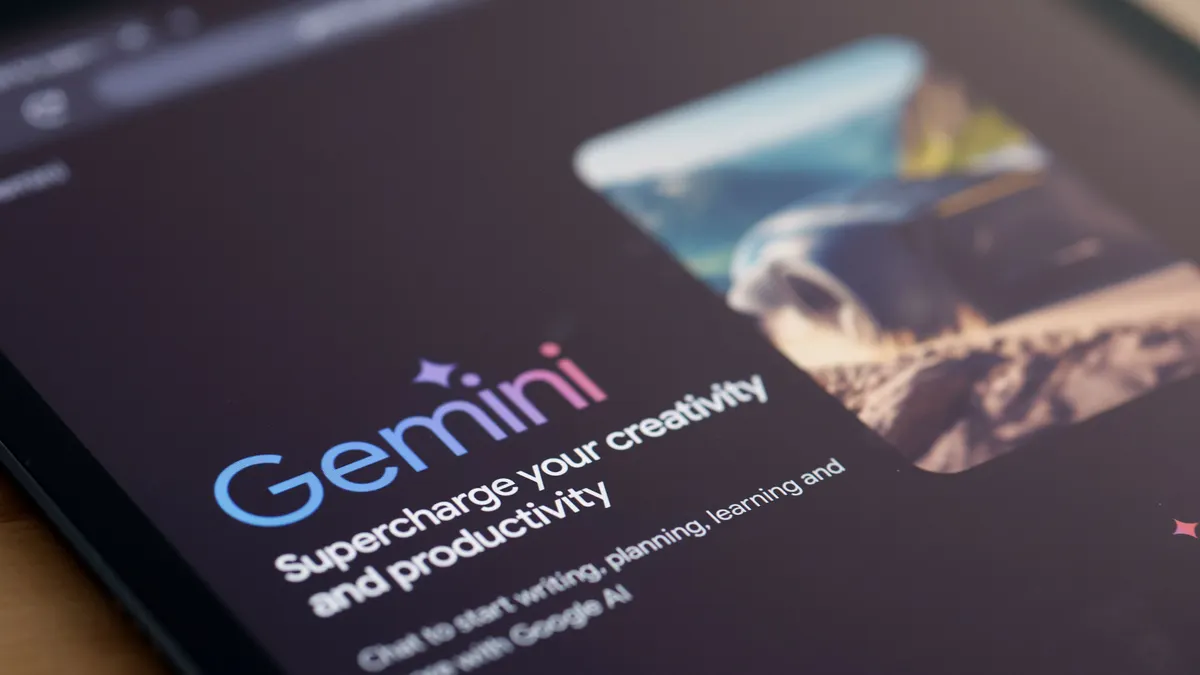
Google has frequently emphasized how generative artificial intelligence is making search habits more winding and complex, transforming a channel that remains the core pillar of its business. A wide-ranging suite of advertising and commerce products announced at the company’s Marketing Live summit Wednesday show how the tech titan is adapting brand experiences to better gel with a more conversational era for search while reducing friction between AI agents and purchases. Some of these new tools also enable advertisers to tap into agentic marketing capabilites underpinned by Gemini for more seamless campaign creation, management and reporting.
Take Ask Advisor, which rolls out later this year and is positioned as providing a unified entry point for in-product agents across Google Ads, Google Analytics, Google Marketing Platform and Google Merchant Center. A haircare brand that wants to identify a new set of customers could tap Ask Advisor to draw up product details from Merchant Center and launch a Google Ads campaign in one swoop, explained Dan Taylor, vice president for global ads at Google. Similarly, Ask Advisor could automatically compile a performance report based on data from both Google Ads and Google Analytics without the marketer needing to do a deep dive into each platform individually.
“On the back end, our agents talk to one another and carry each other’s content, creating a continuous thread of intelligence,” said Taylor of Ask Advisor during a virtual press briefing ahead of Google Marketing Live.
Google is also updating Asset Studio, a hub for creative asset generation that entered beta last August, with fresh Gemini Omni horsepower. Other digital platforms like Amazon are similarly building out one-stop shops for advertising that pose a threat to traditional marketing services providers.
“Brands can now use natural language to describe their goals and upload their marketing brief directly in Asset Studio,” said Taylor. “This means marketers can instantly create a range of high-quality, on-brand assets across text, images and video all at once with a few words or a full marketing brief.”
The Marketing Live bonanza followed Google’s I/O event for consumer products earlier this week, where it debuted a revamped search experience that makes AI a higher priority, including through new customizable “information agents,” and further deprecates the traditional 10 blue links approach. These tweaks come as Google faces stiffer competition from AI startups like OpenAI and Anthropic, and is expected to be surpassed in ad revenue by Meta Platforms for the first time this year, according to some industry analysts.
Adapting search for AI interfaces
Roughly a year after first integrating ads to AI Mode, Google detailed two new explainer advertising formats, Conversational Discovery and Highlighted Answers, that it purports are better tailored to how consumers engage with the feature focused on in-depth chatbot conversations. AI Mode, which has over 1 billion monthly users, will now be powered by the more advanced Gemini 3.5 Flash model globally, Google said at I/O.
Conversational Discovery assesses the context of involved, specific user queries — for example, “How to make a house smell like a high-end spa in a low-maintenance way?” — and spins up custom ad creative from relevant businesses. Highlighted Answers generates a list of curated recommendations based on searches like looking for the best language-learning app for an upcoming trip. An advertiser can slot into that list assuming it is relevant, and Google emphasized that any sponsored picks will be clearly labeled as such.
“These formats are rethinking not only how the ads look, but also the value they provide, because ultimately the best ads are just answers,” said Taylor.
In the core search experience, Google is rolling out AI-powered Shopping ads for high-consideration purchases that include explainers about why the advertiser’s product is the right choice. AI-powered Shopping ads will be available in the U.S. later this year.
Another new AI format that tries to go deeper on complex searches is called Business Agent for Leads, which is now in beta in the U.S. A student exploring the right university to attend could click on an ad to instantly chat with an agent that is trained entirely on the advertiser’s website, removing the need to fill out a static form.
“These ads show when relevant not just to the person’s query, but also the AI Overview response,” said Taylor.
Tying AI to transactions
Google I/O saw the unveiling of an agentic Universal Cart shopping tool that will be available across multiple Google platforms, including search, YouTube and Gmail. A theme running through Marketing Live was helping merchants create incentives that could encourage transactions while shortening the window to checkout.
For example, Google is expanding Direct Offers, which entered a pilot in January as a way for retailers to present deals directly in AI Mode ads. Direct Offers will now allow advertisers to upload a variety of discounts, giveaways and coupons and leverage Gemini to match or combine the most relevant offers into a relevant bundle based on a user’s search. The format, which has already been used by brands including Chewy, Gap and L'Oréal, will soon expand to travel platforms like Expedia and Booking.com.
“Direct Offers are fundamentally different from Shopping ads because they use the deep context of an AI Mode conversation to serve a tailored deal when someone's ready to buy,” Taylor explained.
To ensure consumers can easily claim these offers, Google is also implementing a native checkout experience within AI Mode, meaning users do not have to leave the feature to complete a purchase. Native checkout is available to merchants using Google’s Universal Commerce Protocol, its open standard for agentic commerce that was unveiled at the start of the year in collaboration with partners like Walmart, Target and Shopify.
“UCP solves a very core challenge of scaling agent e-commerce across the entire web by defining a common language which allows agents to connect to businesses securely and seamlessly,” said Ashish Gupta, vice president and general manager of merchant shopping at Google.
UCP is broadening in several other ways, including through multi-item checkout so merchants can receive larger order value, a buy-now, pay-later option supported by Google Pay and an upcoming checkout capability in YouTube ads so viewers can more easily buy items they see either on mobile or connected TV. For consumers who do not want to complete purchases through Google’s services, they can also now transfer items directly to the merchant site.
“Regardless of how and where the customer completes their purchase, the retailer always remains the merchant of record with UCP,” said Gupta.