During last week’s upfront presentations, leading media companies made their big pitches to secure advertising dollars, enlisting Hollywood talent and audio-visual flair to punch up programming slates and digital capability offerings. Across the sometimes literal dog-and-pony shows were several reminders of how these presentations continue to evolve to meet changing consumer behaviors and advertiser demands.
"The biggest shift heading into this year’s upfronts is that TV is no longer insulated by awareness-only measurement expectations,” said YJ Kim, strategy director at consultancy AI Digital, in emailed comments. “Premium reach still matters, but measurable business impact is increasingly what unlocks incremental budget."
Several themes emerged during upfronts hosted by legacy publishers including NBCUniversal, Disney, Warner Bros. Discovery and Fox, as well as tech giants Netflix and Amazon that are relative newcomers to TV advertising. Marketing Dive was on the ground in New York for these showcases, and has assembled key takeaways from a series of presentations that had more in common than not.
Live sports win
The sitcoms and hour-long dramas that previously dominated the upfronts felt like afterthoughts in presentations increasingly dominated by sports.
NBCU is expanding its Sunday night sports strategy from football to basketball and baseball, giving advertisers a more consistent opportunity year-round. Its Telemundo channel will also feature 700 hours of FIFA World Cup programming and be on-site at all 104 matches for the soccer tournament. For its part, Fox will broadcast a record 70 World Cup matches on network television, with 40 in primetime.
“This week, you’re going to hear a lot about the value of live sports and ad-supported streaming. At Fox, that’s not a new story: It’s what we’ve been delivering successfully for years,” Fox CEO Lachlan Murdoch said during the company’s presentation. “Fox is the leader in live programming and home to one of the fastest growing ad-supported streaming platforms in the business. That combination isn’t accidental — it’s intentional.”
Streamers Netflix and Amazon talked up their NFL offerings, with the former adding three additional games to its slate and the latter continuing to find success with its football programming. Amazon Prime Video’s “Thursday Night Football” delivered its largest season-long audience in the show’s 20-year history, and the streamer’s wild card game presentation drew 31.6 million viewers — the most-streamed NFL game of all time.
“Prime audiences don’t merely tune in, they lean in,” said Charissa Thompson, a sportscaster on Prime Video, during the Amazon upfront. “Our audience is younger and more likely to engage with advertised brands than sports viewers on any linear network.”
Not to be outdone, Disney is preparing for what ad chief Rita Ferro described as the company’s “biggest year ever,” with cultural tentpoles including the Oscars, the Grammys, New Year’s Eve programming, the College Football Championship and — for the first time — a Super Bowl broadcast on both ESPN and ABC. The company expects to see a 55% increase in NFL impressions year over year, according to Ferro, and command 40% of all football impressions across the college and pro seasons.
“In a marketplace where everyone is racing to assemble what we already have, Disney is in a category of one,” said Josh D’Amaro, during his first upfront presentation as Disney CEO.
Data is key
Aside from sports, all upfronts publishers positioned themselves as strongholds of consumer fandoms that drive engagement for brands using data-driven, artificial intelligence-powered technology. Those assets connect the dots between buying, optimizing and measuring campaigns across linear, streaming and beyond.
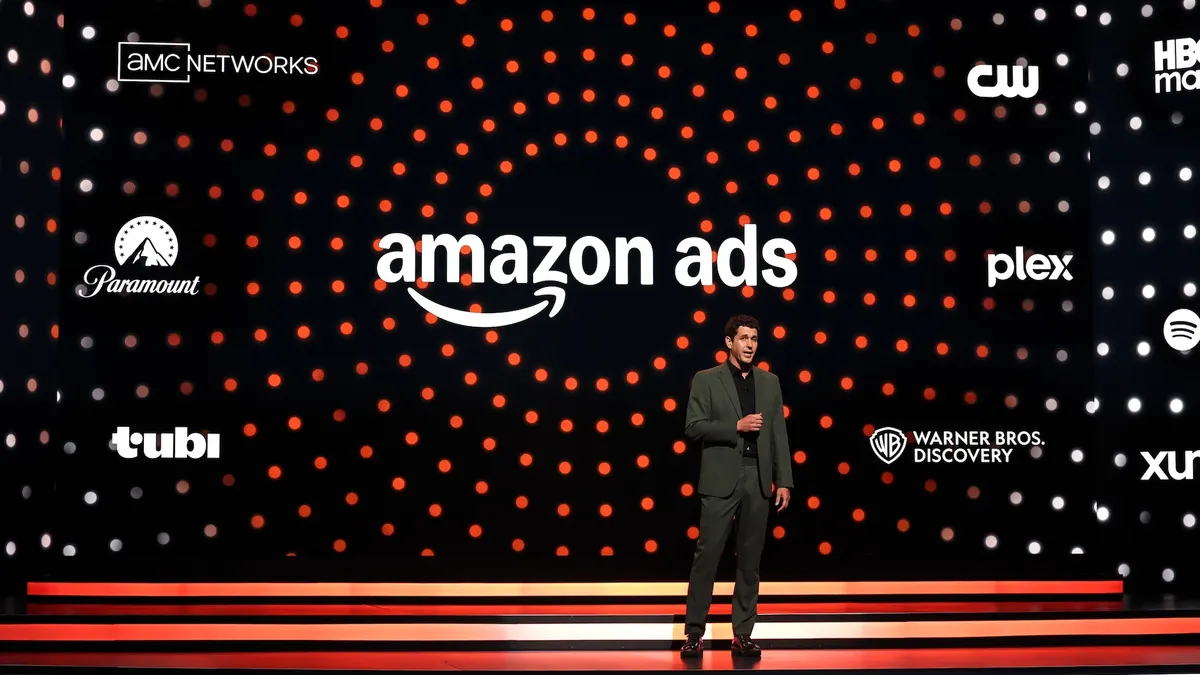
Perhaps no company can better stake its claim as the leader in data than Amazon. The tech giant now connects more than 300 million ad-supported consumers in the U.S. across its portfolio, giving Amazon the industry's largest authenticated reach — 90% of U.S. households — and helping reduce waste while generating higher click-throughs and conversions.
“These signals are not modeled. They’re not assumed. They’re built on trust,” said Tanner Elton, vice president of U.S. ad sales at Amazon, on stage at the upfronts. “These signals give us unparalleled precision. That precision drives performance, and that performance delivers outcomes that matter.”
Fox also trumpeted its reach of more than 200 million people every month across over 1 billion devices. It boasted of linear audiences that have increased by double digits over the last four years, a period where industry-wide linear audiences declined 33%. Growth has been spurred by Tubi, which Fox acquired in 2020, while the network in April retooled its advertiser solutions around the Fox AdStudio. The AI-supported offering features a converged audience graph that incorporates billions of data points and a measurement engine that provides reporting via more than 20 data partners.
“Engaged fans are your best customers. They’re 21% more likely to purchase your products and 30% more likely to remember your ads, which is exactly why we launched the Fox AdStudio and its suite of full-funnel measurement solutions,” Fox ad chief Jeff Collins said during the upfronts. “To date, AdStudio has delivered advanced outcome reports for over 1,000 campaigns showing double-digit lifts in key metrics like in-store sales and foot traffic.”
As part of its upfront presentation, Warner Bros. Discovery launched an Always-On Measurement & Attribution Dashboard that provides real-time visibility into campaign performance and enables in-flight optimization towards outcomes. Meanwhile, NBCU, a longtime innovator in data and measurement, said it plans to roll out its previously announced Performance Insights Hub in Q4. The hub integrates measurement from leading firms like iSpot, VideoAmp and EDO and, at the ufpronts, NBCU revealed Instacart is serving as its exclusive CPG outcomes partner.
AI powers dynamic, contextual ads
Unsurprisingly, one of the main applications for data usage by media companies is building out AI-powered tools that look to make the advertising process more efficient and engaging.
Amazon Ads continued to develop AI tools with the introduction at its upfront presentation of Dynamic TV Creative, a capability that automatically personalizes Interactive Video Ads based on viewer shopping behavior. The tool uses Amazon’s signals plus AI-driven creative optimization and campaign management abilities to adjust format, call-to-action, headline and details depending on where shoppers are in their journeys.
“This moves away from a one-size-fits-all approach, creating a more relevant experience for audiences while streamlining campaign management and execution for brands and helping their marketing dollars work harder,” said Fabrice Rousseau, director of CreativeX at Amazon Ads, in a press statement.
The capability is currently available to select U.S. advertisers in categories including CPG, fashion and electronics that sell on Amazon via Prime Video campaigns. It will expand to more customers and inventories in Q3, and is already being used by The Hershey Company.
Warner Bros. Discovery continued to build out its suite of solutions and formats for advertisers, even if the company’s acquisition by Paramount represents “the Ellison — I mean, the elephant — in the room,” as Bobby Voltaggio, co-president of U.S. Advertising Sales at WBD, joked during the presentation.
Along with shoppable pause ads that have been become table stakes for streaming services, WBD announced Scene Level Moments, contextual targeting powered by Kerv.ai; Dynamic Creative that adapts ad headlines and visuals contextually; and Agentic Experiences that tap into growing interest in agent-to-agent advertising.
Likewise, Fox’s Ad Studio includes a contextual engine powered by an large-language model that connects brands to the content moments to provide ad insertion using scene-level targeting. NBCU also announced plans to expand contextual targeting and roll out always-on AI agents, while Netflix noted that its years of experience with AI and machine learning have helped advertisers including DoorDash, Target and TurboTax.
The rollout of AI tools across publishers meets advertisers where they are in their journeys with the technology. Four in 10 advertisers are testing AI creative this year while over one third are exploring AI workflows and operations, per an iSpot report shared with Marketing Dive.
“The 2026 advertising environment is defined by a decisive pivot toward precision. Marketers have moved past the experimentation phase of AI, now integrating full-scale workflow automation to optimize efficiency,” according to iSpot’s 2026 Video Ad Spend and Strategy Report. “While spending forecasts remain cautiously optimistic amid economic shifts, budgets are increasingly concentrated in channels that offer the highest degree of accountability.”