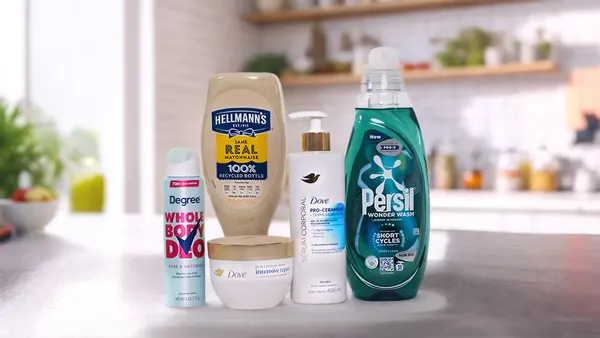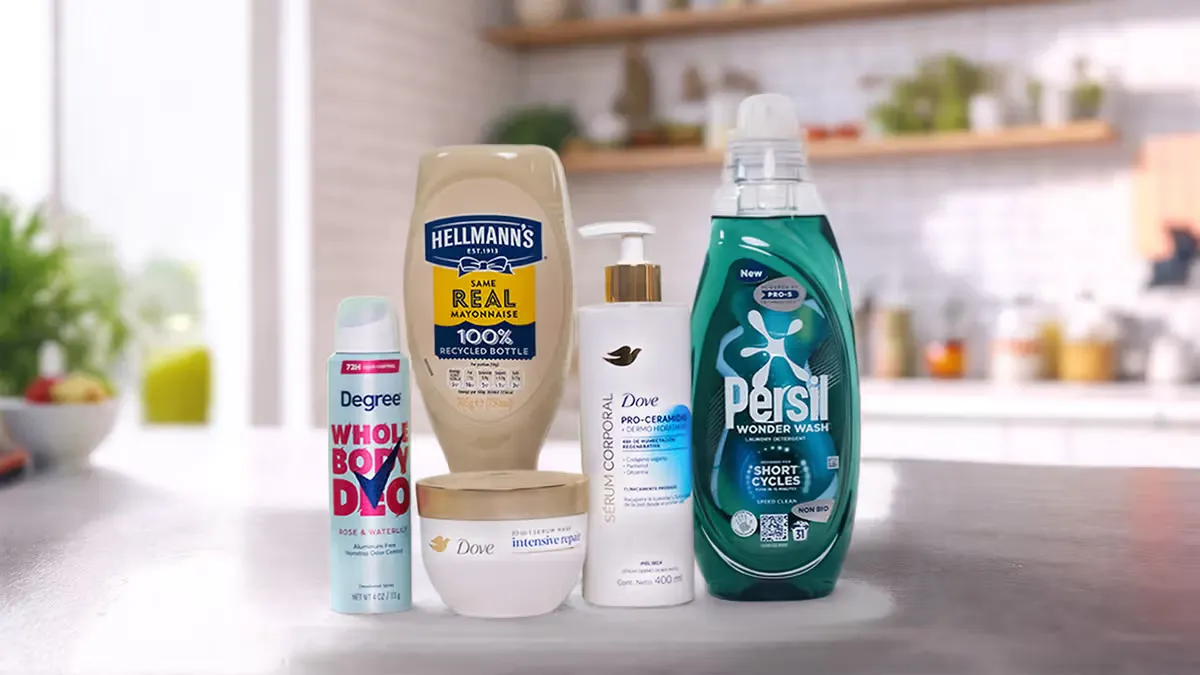
After seeing strong sales and volume growth last quarter, Unilever upgraded its outlook for the rest of 2026 and now expects at least 3% underlying volume growth for the full year. But the CPG giant is not standing still as it looks to build on that growth: At an investor event last week, the company announced plans to roll out a reorganized operating model in 2027 that will be centered around a “global strategy, local execution” principle.
Unilever’s operations will be split into six global units, with leadership responsible for, among other things, managing the growing convergence of content, media and commerce. In addition, Leandro Barreto, currently chief marketing officer of Unilever and its beauty and wellbeing business, will be appointed chief growth and marketing officer on Jan. 1, a move that’s in line with how other marketing leaders are adding responsibility for the P&L.
The reorganization arrives as Unilever continues to evolve into a pure-play home and personal care company following the separation of its ice cream business last year and the planned spinoff of its food business as part of a $44.8 billion deal with McCormick. The latter hit an antitrust snag in the U.K. this week that Unilever described as an “expected step” in the process.
Moving forward, Unilever plans to focus on four pillars when operating its brands: increasing the role of wellness, developing authority systems, executing flawlessly and remaining committed to a marketing philosophy it implemented last year called SASSY, which is an acronym for superior science, aesthetics, sensorials, shared by others and young spirited principles.
The “shared by others” part of SASSY includes the company’s work to shift half of digital ad spend to social-first and creator-driven marketing. Unilever reported that it now relies on 500,000 content creators, up from the previously reported 300,000 and significantly more than the 20,000 utilized before CEO Fernando Fernandez joined the company.
“We have embraced social-first marketing at a very significant speed, and this is showing in the way we are growing our key brands,” Fernandez said at Unilever’s investor event on Nov. 4. “Some of our brands have been really rejuvenated… Have we done it in all our portfolio? No. We have great examples, and we have brands in which we are starting to replicate this model.”
Currently, authority systems in a content-overloaded, artificial intelligence-powered world mediated by agentic shopping and LLMs represent a gap in Unilever’s strategy and an area where some competitors have outperformed the company.
“The algorithms have to follow a logic, and the logic they follow is geographical proximity, independent recommendation, clinical proof, patents published, ratings and review. This plays in favour of great brands with great science, with great budgets,” Fernandez explained.
AI acceleration
AI is affecting Unilever’s business in a variety of ways, including shifting the innovation process from primarily being a physical discipline to a digital one. The company can now develop consumer signals into validated concepts in hours instead of months.
“We now can see very clearly how the signals are operating, and we can, with synthetic audiences, not only spot more than 60,000 consumer signals in a continuous way, but we also can sharpen those ideas before even real consumers see them,” Barreto said during the investor event. “The innovation also is leveraging way more data points, more than 25 million of them. That's why we can match the formulation with the concept, and we can have predictions on performance and consumer appeal.”
Unilever’s social-first marketing model involves four areas at scale: recommendation, content, influence and media. To solve for recommendation that is mediated by LLMs, Unilever said it is structuring its data to be machine-readable, working with partners like Google and optimizing by tracking more than one million prompts across more than 30 markets. In the last six months, Unilever has improved in more than 90% of the brand market sales positions that it tracks.
The company is using an AI-powered engine to meet the scale and speed of its content needs, and reports that it is producing twelve times more content than in 2024 at a 90% lower cost. In some cases, purchase intent and brand recall have increased, due in part to training AI on each brand’s DNA and core proposition. AI is also helping Unilever find, brief, vet and measure creators whose content yields ROI that is 1.5-times higher than brand-led content.
The proliferation of AI is also one of the factors reducing the lifespan of video content to four days. After that time, content on platforms like Meta, Google, TikTok, Amazon and Walmart has negative — not simply diminishing — levels of return, making marketers like Unilever rethink how it approaches content.
“The level of engagement that you provide to the platform fundamentally changes the price you pay. This is a fundamental change and makes development of content such an important capability in a company these days,” Fernandez said.
Unilever said it has dramatically reduced the cost per unit of content and improved its return on investment between 10% and 15% per year. However, that ROI is not expected to return to the company’s P&L or bottom line, but serve as a cost of doing business in a digital media environment.
“In the past, a company like Unilever could gain a significant competitive advantage by purchasing large amounts of media from TV Globo in Brazil. Today, however, media is being purchased through Meta, Google, Amazon, Walmart and TikTok, and that model no longer favors scale of purchase. Instead, it favors the quality of engagement you generate on the platform,” Fernandez said. “I believe improving our return on investment is fundamental to keeping our business model working, continuing to drive top-line growth and delivering modest margin expansion every year.”