On average, U.S. consumers spend about two and a half hours per day on social media, with Gen Z topping five hours a day, per S&P Global Market Intelligence Kagan data. Walmart is looking to connect with these consumers with a robust social commerce strategy that includes driving consideration across channels and building capabilities that make it easier for creators to collaborate with the retail giant, according to a session at the Association of National Advertisers’ Media Conference on March 25.
The company works to connect with consumers where they are spending their time to create moments around shopping-focused missions and zeitgeist-inspired impulses. For Walmart, social commerce spans ads on social platforms, shoppable experiences, hundreds of thousands of influencers and platform capabilities.
Behavioral trends in the space revolve around the evolution of search, social algorithms and the growth of content creation. Consumers — especially millennials and Gen Z — are increasingly beginning their searches on social media rather than a traditional search engine, and they expect results to be conversational, explained Sarah Henry, the head of content, influencer and commerce at Walmart, during the session.
“We’re increasingly looking at what those top query searches are and figuring out how we incorporate them,” Henry said. “In some cases, we are asking the creators to develop content that answers a specific search query.”
In addition, using followers as a social media metric is also losing favor as the algorithms powering TikTok and Meta’s platforms are more driven by intentional video engagement measures like replaying, saving and sharing. In kind, content creation is not just for influencers with mass followings. There are 27 million paid content creators in the U.S., according to some estimates, and that number could grow as younger consumers follow their passions into content creation.
“It’s not just about having content on there and hoping that someone sees it, nor is it about having followers and creators that have a lot of them,” Henry said. “It’s actually about having an intentional keyword strategy and intentional content that's actually going to resonate with what people are watching.”
Working with creators
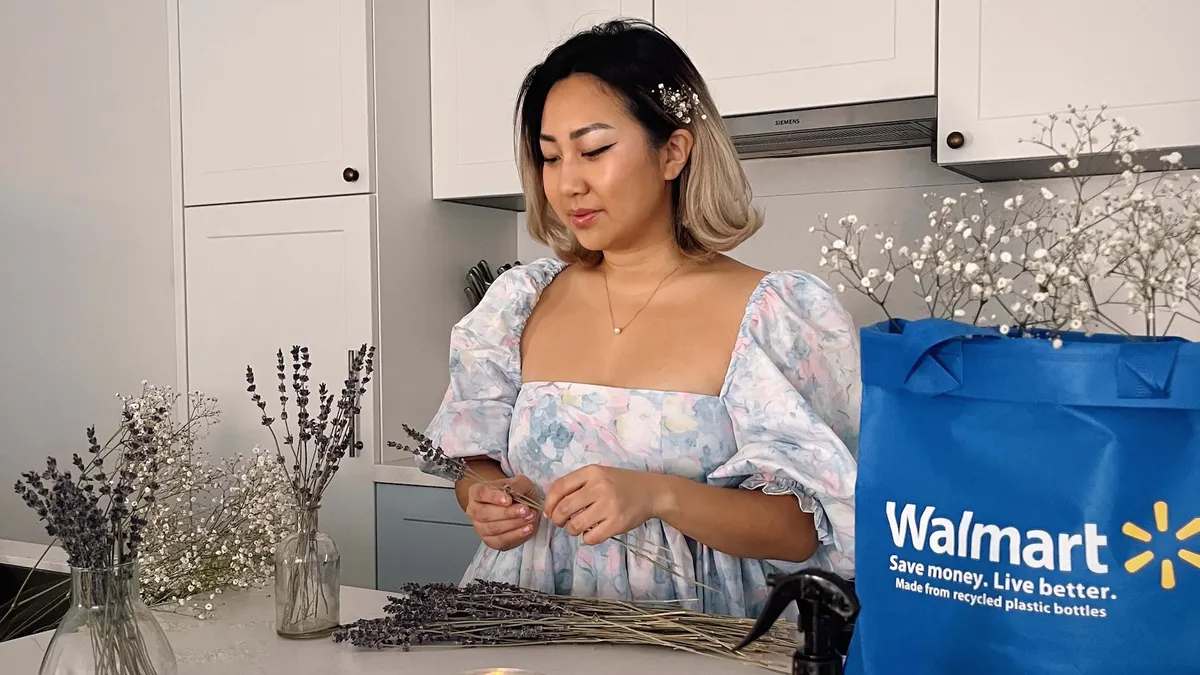
Walmart has used social content as part of its “Walmart. Who Knew?” campaign that launched in 2025 to change consumer perceptions of the big-box store. That content has focused on Walmart’s half-a-billion-strong product assortment, inclusive of first-party merchandise and third-party marketplace sellers, as well as services like express delivery and a Walmart+ membership program that includes perks like free shipping. Walmart has enlisted influencers to better emphasize the range of fashion and styles available online and at its stores while promoting express delivery as a boon for parents.
“The beauty of these videos, and the balance that we try to strike, is we know that these creators have … built up their communities, and they’re the ones that know their audiences and their content best, and so the worst thing we could do is be super prescriptive and tell them to cover a prescriptive message,” Henry said.
While Walmart guides creators on the brief and RFP around product assortment and value proposition, the company gives them flexibility in what they do in their content. That approach has helped influencer and creator marketing do double duty for Walmart: it is not only driving traffic and sales, but also creating moments of discovery that make other channels, including search and display, work harder and more efficiently.
The Walmart Creator program centralizes how the company works with creators and has grown “substantially” since its beta launch in 2022, Henry said. Built with an affiliate program at its foundation, Walmart Creator lets creators monetize their content through shoppable products, earning a revenue share off products sold.
“It has exploded in terms of creator growth, creator demand and the value that creators are finding out of this, and it also has significantly increased the amount of social content that we have out in the space,” Henry said.
Along with commissions, creators get access to brand deals and tools that make it easy to create content and see performance. Walmart Creator also recently launched a collaboration function that enables sellers and creators to work together. The automated, self-serve product helps marketplace sellers find the right creators to promote their products and set their own advertising and commission rates, with users of the Walmart Creator program getting access to those offers.
Walmart has also rolled out artificial intelligence-enabled tools that help creators figure out which products to focus on and streamline their content creation process. These tools include a Trend Corner feature that brings together trend intelligence and other signals to identify trends in culture and consumer conversations.
Principles for working in social
During the session, Henry shared several principles that drive how Walmart operates in the social space. The company puts creator and customer value first, looking to solve for pain points and shorten paths to conversion, like a recent partnership with Pinterest around shoppable recipes. To strike the balance between flexibility and brand objective, Walmart embraces originality in creators.
“It’s really easy as a brand to get caught up in, ‘What is the campaign? What is the brief? What am I trying to accomplish? What's the exact thing I need the creator to say, and how is that going to come out in a content, in a way that my boss is going to sign off?’” Henry explained. “It’s up to the creator how and where they want to say it, as long as they’re following compliance and FTC guidelines.”
Walmart has also worked to innovate around where consumer behavior is going next, especially as creators build up their profiles on TikTok and Instagram and then move to platforms like Substack and Reddit. Similarly, the company has embraced speed in trend intelligence to avoid chasing the bandwagon and making the brand feel like it’s behind culture.
The company is also exploring how to best measure its creator activity, a nascent space that is growing in importance as retailers, CPG brands and others increase investment in social-first marketing. Often, behavior in the space must be measured over a longer time period.
“If we were to base our success of whether influencer or creator marketing worked on the performance that we were seeing five years ago, we might have made different decisions,” Henry said. “What we decided to look at was what is happening beyond the transactional trend, what type of customer perception and what behavior is it driving.”
Walmart uses a number of different attribution methods, including last-click digital models that take in-app and website sales into account and traditional media mix models that look to solve for incrementality. But as with other marketing spaces, including connected TV and retail media, the brand is desiring more robust solutions that can paint a full picture of creator performance.
“I would love a silver bullet metric that holds as much water as something like transactional and customer value does,” Henry said. “I think we can look at lots of different diagnostic metrics, but at the end of the day, it is important for us as an industry to come up with some sort of series of metrics that is measuring awareness and engagement on the same kind of basis.”