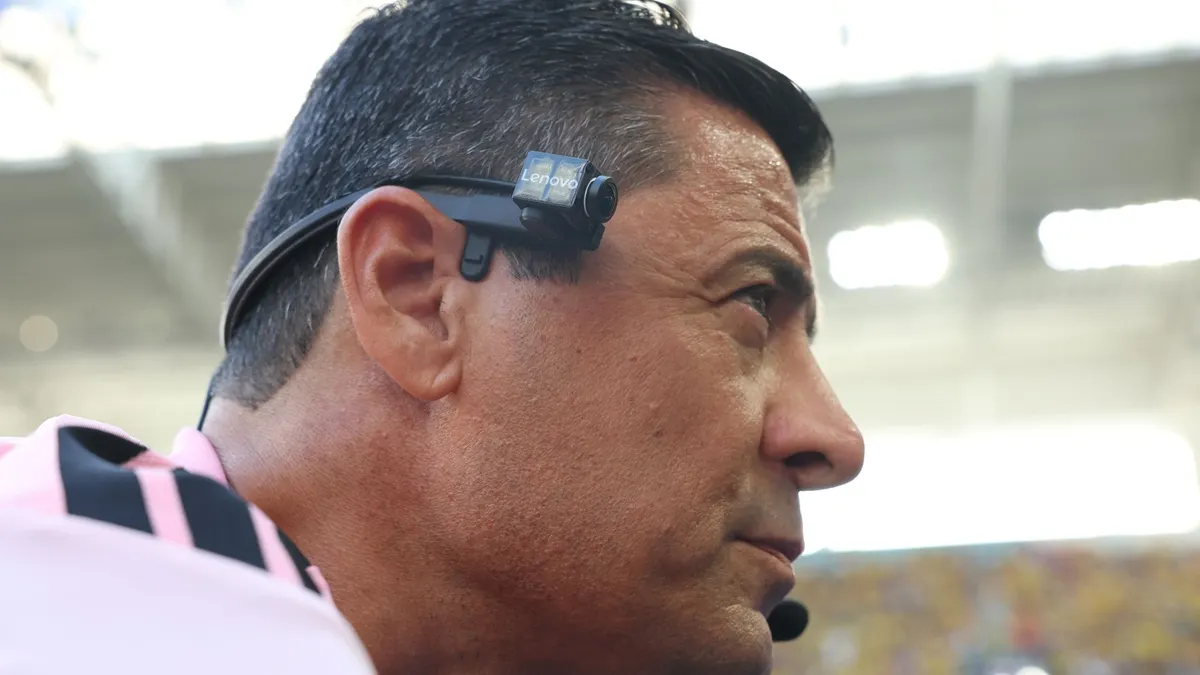
Lenovo used its FIFA sponsorship to put its artificial intelligence tools in front of billions of viewers. From the Lenovo AI Referee View to an ad campaign featuring soccer superstar David Beckham, the tech company looked to put itself front-and-center during one of the most watched sports programs in the world. And it worked, earning the brand 4.4 billion social impressions and 1.8 billion creator/influencer impressions, per data provided by the brand.
Over the course of the tournament, Lenovo said it saw a 4.2 times lift in brand consideration among tech-focused soccer fans and a 4.2% lift in brand value. It also claims to have captured the top competitive share of voice among FIFA partners on social media and driven 460,000 page views to Lenovo-owned sites.
Lenovo North America CMO Milo Speranzo sat down with Marketing Dive to talk about making the most of expensive sports sponsorships, how the brand is looking to replicate success with the women’s soccer tournament in 2027 and how it's differentiating itself in the AI race.

The following interview has been edited for brevity and clarity.
MARKETING DIVE: What went into Lenovo’s World Cup sponsorship? What was the brand looking to achieve?
MILO SPERANZO: Having the same goals, the same messaging and storytelling, as well as the ability for us to integrate our product and technology into the actual event was a key pillar in that decision making of, do we go all in? With FIFA and the World Cup, there's no partial in, or at least doesn't feel like it.
It's an all-in engagement, and when we made that decision in 2024, we were very confident that we had covered all three of our determination silos that we look at in order to really ask ourselves: Will this be a successful partnership? [Those silos are] tech integration, can we tell an authentic story and then the marketing KPIs on the back half. Those three pillars for the World Cup just lined up perfectly.
Was the World Cup a successful partnership for the brand?
Yes, it was. When we look at a return on investment for a partnership, the brand piece is a third of what we judge ourselves on. I would say that all of our marketing-specific KPIs were exceeded. It was very much an awareness play, as well as educating our customers that we are not only products. We are a very deeply resourced supply chain-resilient technology solutions company that has a massive AI portfolio.
How did the partnership with David Beckham come together?
David is an amazing representative of our brand. He is a wonderful personality for one, but two, he also has an eclectic mix of hobbies. He’s a chicken farmer, small business owner, he builds motorcycles. He embodies what we would consider a potential super-user, and he does use Lenovo. He's very much a brand ambassador of our product line, so when we looked at potential spokespersons for the World Cup, the Beckham-soccer fit was very natural. Lenovo is a global brand. FIFA is a global property, so we did not look at it as a U.S. spokesperson. We looked at it as a global spokesperson.
What are your plans for the Women’s World Cup in 2027? Are you taking a different approach?
It's a very different audience. [For the men] we saw massive North America engagement when the North America countries were engaged. We saw engagement stay higher than expectations, drop significantly after the U.S. and Canada were out.
For the women, our U.S. and Canadian teams are just powerhouses. During the men’s tournament, we planned for a lot of our early bespoke, larger events, larger engagements to be really in those early to quarterfinal rounds, and then transitioned to a lot of branding and hospitality as we got into the semis and the finals. For the Women's World Cup, we have to think of it very differently because the eyes of my audience here in North America, I believe, are going to be affixed to this equally across the entire tournament, hopefully all the way into the finals.
There has been a lot of talk around investment parity between men and women’s sports. How does Lenovo’s investment into the women’s tournament compare to the men's?
For us in North America, the marketing KPIs for the Women's World Cup we feel will exceed what we saw during the men's. That’s for the reasons we just spoke about. Canada and the U.S. women are powerhouses. So, we're really excited to double down in areas that maybe we didn't double down during the men's World Cup.
The men's had more countries, it had more games. There's less [with the Women’s World Cup]. We have a chance to focus our energy, especially our marketing energy, on fewer, bigger campaigns. It'll be everything from bespoke events to hospitality, just being there, to physical sponsorships, to fan fests. There's going to be a couple large fan fests in Rio de Janeiro and Sao Paulo that we’ll have a pretty big presence at.
Tech companies are starting to heavily invest in sports sponsorships to promote AI products. How is Lenovo working to stand out in an increasingly crowded field?
As far as differentiation in the tech stack, everybody says they're everything to everybody. In reality, from an ecosystem perspective, Lenovo is the only technology provider that can provide everything from phone to PC to all the adjacencies, the cold screens and mice and portables and battery backups, all the way to the most complex data center solutions.
The answer [to standing out] is storytelling. You'll see a lot of tech companies attach themselves to a brand or a sports brand or a property, but only tell that story as it resonates with the sport. We need to tell that story so it resonates beyond the sports where you're just not getting the value that you should get out of what is a very expensive partnership.