

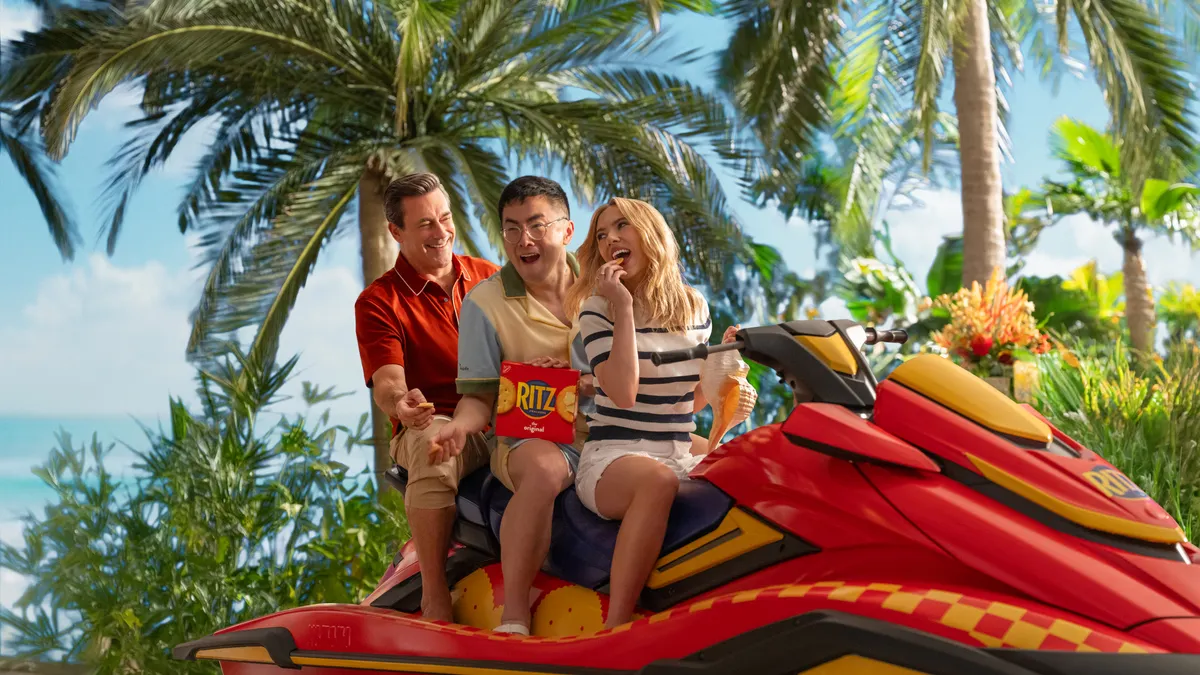
Ritz is further broadening its image beyond a wholesome snack platter cracker with its second Super Bowl campaign. The Mondelēz International brand is returning to the big game with a 30-second ad running in the third quarter that is set on Ritz Island, a tropical paradise populated by the salty celebrity personalities of Bowen Yang, Jon Hamm and Scarlett Johansson, as well as buzzing beachside parties.
The snacks marketer is squarely focused on shoring up brand equity during a night that is expected to see others in the packaged foods category hammer on health and wellness-oriented traits, like fiber content. “Ritz Island” is part of a larger effort to embrace culture-forward messaging that could appeal to younger consumers, a strategy that kicked off with Ritz’s Super Bowl debut last year. The Martin Agency handled both big game campaigns.
“It was the first step in ‘25, and ‘26 is our chance to drive consistency and reinforce that message that we are evolving this brand from a fairly safe and predictable brand to something that’s a little bit more playfully self-aware, a little bit more culturally fluent,” said Olympia Portale, senior director of marketing at Ritz.
Stoking excitement
“Ritz Island” was first teased last week in an Instagram video where Yang rings up a friend whom he refers to only as “Prosciutto,” now revealed to be Hamm. The full spot shows Yang and Hamm grumpily commenting on not getting invited to a Ritz beach party from afar. They mutually decide to put aside their grievances and pop in for five minutes, but don’t want to get their feet sandy. Johansson comes to the rescue on a land-ready — and Ritz-branded — jet ski.
Ritz is supporting the commercial with a multichannel campaign that spans organic and paid social content featuring the talent, retail activations and a limited-edition, football-shaped cracker.
The latest big game effort expands on the roots of Ritz’s Super Bowl debut last year with the “Ritz Salty Club,” which starred Aubrey Plaza and Michael Shannon as spokespeople who can’t hide their love for Ritz crackers despite a proclivity for crankiness. Bad Bunny, Super Bowl LX’s halftime performer, also made a cameo as a sunny foil. The similarly A-list-heavy “Ritz Island” creative sets a snarkier tone for Ritz’s marketing in 2026, even as its parent company explores shaking up creative elsewhere.
“This is not just a flash-in-the pan moment,” said Portale. “We’re going to be running our [big game] creative for the duration of the year.”
Establishing brand equity
Ritz thinks the salty positioning could resonate with consumers during a divisive point in time. Nothing in the advertising is political, but the approach offers a fun way to tap into the “collective cultural response to these microfrustrations of everyday life,” explained Portale.
“Saltiness is a very modern and relatable emotional state,” said Portale. “There’s the combination of a little bit of mild outrage, ego bruise, some social comparison. The humor and the self-awareness, I think people find quite relatable.”
Ritz doubling down on the Super Bowl comes as parent Mondelēz mulls a review of its U.S. creative agency roster, which includes Martin, now part of Omnicom. The move follows Mondelēz hiring former Inspire Brands exec Travis Freeman as senior vice president and global head of consumer experience.
“In order to continue evolving our marketing excellence and those muscles, we periodically review our agency partners to make sure that all of our brand needs and expectations are being met,” said Portale of the review. “[Reviews are] standard practice and the goal is really to continue to foster that creative thinking and support those long-term marketing objectives.”
As with “Ritz Salty Club,” the brand is assessing the success of its latest Super Bowl work on two fronts: traditional business metrics, like sales growth and household penetration, and equally important but harder-to-pin-down cultural relevance measures.
“The goal is to strengthen and solidify the Ritz brand equity,” said Portale. “Engagement and buzz and social credibility is going to be a leading indicator of that.”