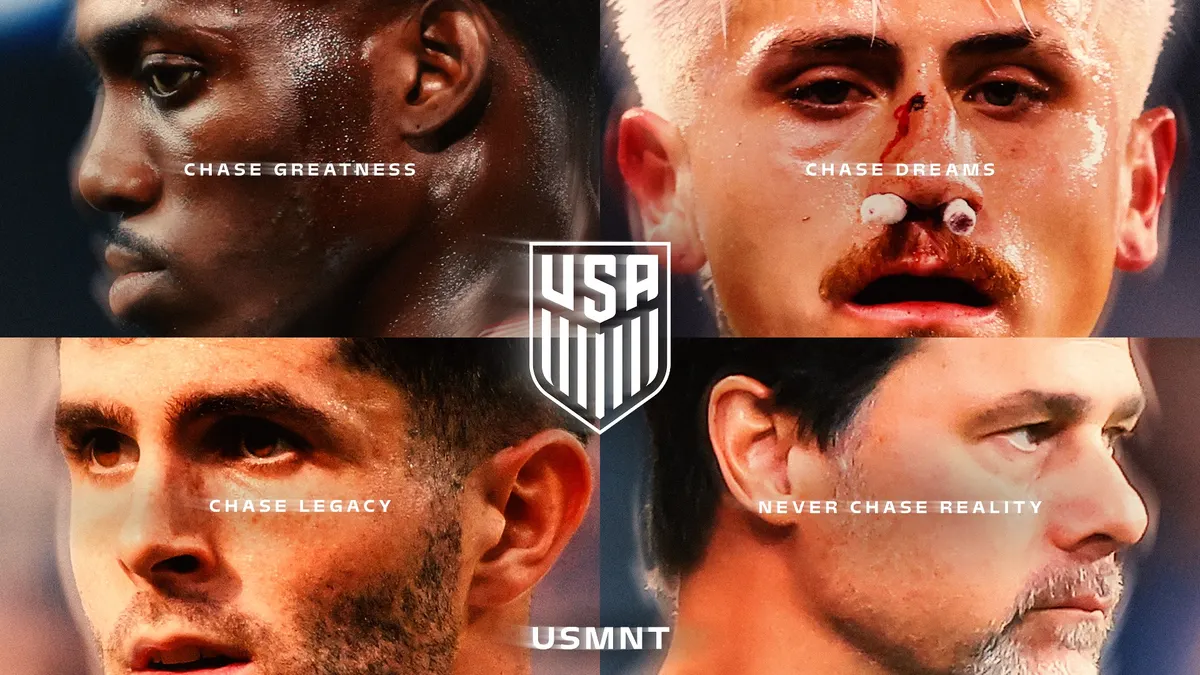
U.S. Soccer launched a new campaign, “Never Chase Reality,” in support of the U.S. Men’s National Team — and fans across the country — ahead of next summer’s 2026 FIFA World Cup. The campaign’s early December launch was timed to coincide with the final draw that set the table for the global soccer tournament, which will be co-hosted by the U.S. for the first time since 1994.
Anchored by a 90-second video, the campaign chronicles iconic moments in U.S. Men’s National Team’s history and puts the team’s chase for the cup in line with other American traditions. The tagline encourages players and fans to “chase greatness, chase dreams, chase legacy, but never chase reality.”
The campaign was created in-house by the new marketing and communications department at U.S. Soccer, the nonprofit body that governs American soccer at the international, professional and amateur levels. Billed as one of the largest public-facing efforts from the organization to date, “Never Chase Reality” will run across broadcast, digital, out-of-home and experiential channels, and was informed by a deep psychological profile of U.S. soccer fans.
“We understand how we should be creating our ads and how we should be talking to the fans, but also putting them at the heart of everything that we do,” said Catherine Newman, chief marketing and communications officer at U.S. Soccer.
Newman joined U.S. Soccer in July 2024 with a remit to reset the organization’s marketing function ahead of the Men’s and Women’s World Cup tournaments and the 2028 Summer Olympics — events where increased fandom around soccer has attracted major marketers including Unilever, Kellanova, AB InBev and more.
Marketing Dive spoke with Newman about the genesis of the campaign, the roadmap ahead for U.S. Soccer and lessons learned during her previous marketing role for WWE.
The following interview has been edited for clarity and brevity.
MARKETING DIVE: What drove the creation of this campaign, which has a real emotional component?
CATHERINE NEWMAN: Soccer is always about more than the game. It's always emotional. There's a saying in the UK that “soccer is more than life,” and I think it translates well for everybody. We wanted to work closely with Mauricio [Pochettino, head coach of the USMNT] and his team and the players, because we wanted to reflect the sentiment that they're feeling: the drive, the ambition and the journey that they're on. But we also wanted to acknowledge the journey that soccer has been on in the U.S. for a number of years. From a fan sentiment point of view, they want to understand how the team is feeling, and to be part of the journey.
The script talks a lot about “us,” and that “us” isn't just about the team, because we have the 12th man — we have the fan. We wanted to make sure that we created something that recognized the team as a complete circle: the coaching staff, the staff at U.S. Soccer, the men's team and then the millions of people who are going to be supporting the team at the tournament.
How did you balance in-house and outside agency responsibilities to bring the campaign together?
We produced this in-house. We reset the marketing communications function and brought it together, so we now have a holistic view across everything we do as a brand, which we didn't before. Part of this has been science, and part of this has been creativity, which I think is where the best ads always live: they understand the job that they need to do, but they are data-informed.
The brief was very rich for the creative team, but also our content team, who helped produce this ad and are also with the players, day in, day out. We travel to Europe with them at times to capture content, but when we're in camp with them, we are there, 24/7, so it enables us to make it in-house, because we have an insight that no agency could ever hope to have in that respect.
Whilst we have an agency partner in M+C Saatchi… we felt very confident in the capability of the folks in-house. We were trusted with something so intimate — the thoughts, hopes and dreams of the players and the coaching staff — that it felt like we were very well equipped to make that in-house.
Can you tell me about U.S. Soccer’s media and content strategy?
We obviously have our owned and operated channels, and we will be doing paid as part of this [campaign]. But we also have 118 members organizations and a large fan database. Those people will see the ad first. They are our most precious media and distribution channels, because there are members, coaches, referees, volunteers and staff, and our most loyal fans, so we are actually putting the ad in the hands of those folks to actually push it out first. It will then appear on broadcast media, which is no surprise, and will actually be featured in Times Square.
But this is also a campaign that is going to live for many months. The sentiment encapsulates the journey that we're on, of which the tournament is one part, but it will very much continue. So you will see this campaign evolve, just like our journey will be evolving. So you'll see the media continue in that respect.
We are also working with a number of partners, as well, to make sure that we are building our own affiliate network for U.S. Soccer. We are looking at seeding out our content with a few selected media partners. Snap is one of them, for example. They are now a distribution partner for us, and we work with them in a very different way for our content, and making sure that they have exclusives.
How is the organization balancing its marketing needs during the fraught political moment in the U.S.?
Ahead of “Never Chase Reality,” we launched our Soccer Forward campaign called “Keeping Score of What Matters,” and it talks about soccer as a force for good. Regardless of your politics, a 90-minute game is a great way to spend time with friends and family. It's good for your mental health, particularly if you're physically involved, and it gives people an opportunity to come together.
Part of the psychological driver of the work that we did, [we found] the number one reason that people love soccer above any other sport was it because it was a place that they felt they belonged. We don't check your status when you come in. That's not who we are. If you want to play, if you want to watch, if you want to commentate, if you want to have a view, then you are very welcome in soccer. The World Cup will be a beautiful and unifying moment that everybody in the country can enjoy.
Prior to U.S. Soccer, you were the executive vice president of marketing at WWE. What lessons did you learn in sports entertainment that also apply to sports more broadly?
If I learned nothing else at WWE, it's that every moment is an is an opportunity for a story. It may not always be the one that people want to hear. It may not always be the thing that people hoped for, but storytelling is incredibly powerful, and keeping people updated with what you're doing is just so important.
We are working to share the U.S. Soccer journey much more than we've ever done before, and it's not because we're doing everything right. We're testing, we're learning. We'll make mistakes along the way, but we are hopefully humble enough to understand that we won't get there by ourselves, that we are a service organization. We need the help of our members, partners, donors, fans and staff.
WWE talked a lot about the WWE universe, because they recognize everybody had a role to play, and that could not be more true at U.S. Soccer as well. There are different characters here, for sure. We don't have anyone body slamming anyone in a meeting, but it’s all good fun.