

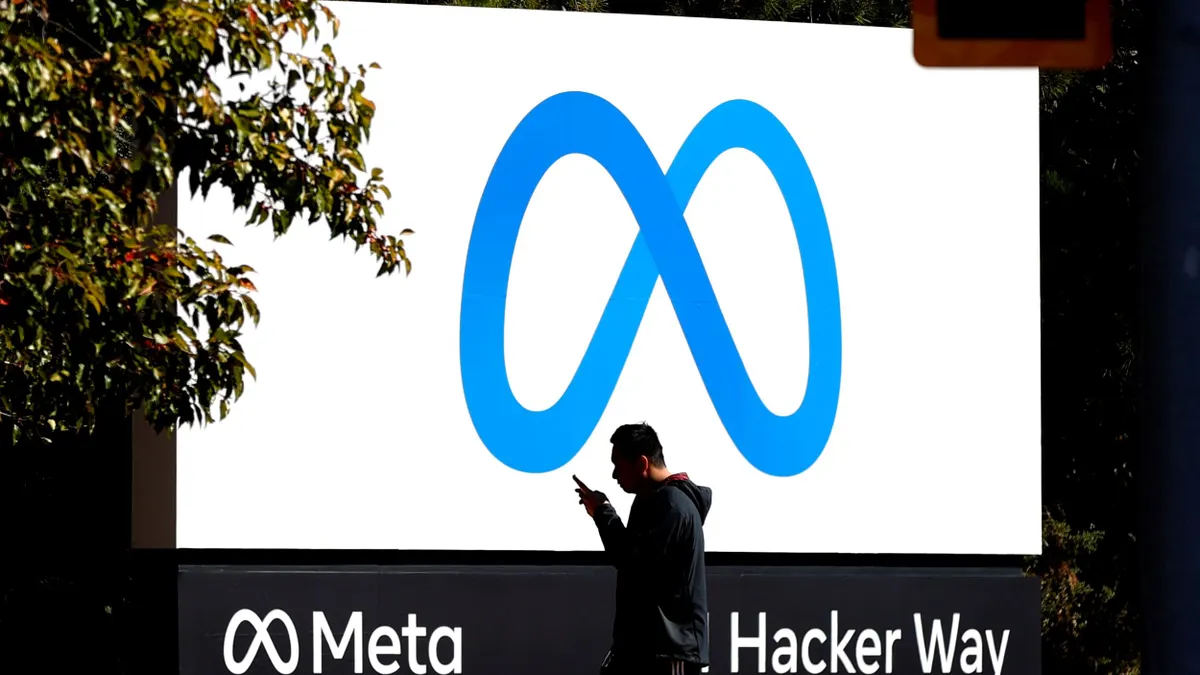
Meta Platforms grew ads revenue 24% year over year to $58.1 billion in Q4, a period that saw record holiday advertising demand and the social media giant continuing to fine-tune its artificial intelligence bets. Executives positioned 2026 as a moment of organizational transformation driven by AI — including the “flattening” of some teams — after years of hype.
“We are now seeing a major AI acceleration,” said Meta CEO Mark Zuckerberg in prepared remarks. “I expect 2026 to be a year where this wave accelerates even further on several fronts.
Overall ad impressions at Meta rose 18% YoY for the quarter ended Dec. 31 while the average price per ad ticked up 6%, a reflection of higher demand, according to an earnings statement.
Discussing his long-term AI vision, Zuckerberg illustrated potential use cases like writing a prompt to create a personalized video game through Meta’s Horizon Worlds platform that can then be shared within a user’s social network. The near term will see the company continuing to double down on what’s already working on the business front while the specifics of more complex AI applications are ironed out.
“We are focused on things beyond ads. I think the numbers make it so that for the next couple of years, ads are going to be, by far, the most important driver of growth in our business,” said Zuckerberg on a call discussing the results with investors. “All these things, even if they scale very quickly, are going to take some time to be meaningful at the scale of what the ads business is.”
On the back end, Meta is leveraging AI to improve its ads ranking and learning models that analyze user behavior. In Q4, the company doubled the number of graphics processing units dedicated to training its Generative Ads Recommendation Model and made other tweaks that, taken together, resulted in a 3% lift in clicks on Facebook and a 1% boost to conversions on Instagram, CFO Susan Li said.
Advertisers are also experimenting more with Meta’s generative AI tools for campaign creation. The company’s video generator offerings reached a combined revenue run rate of $10 billion during Q4. Quarter-over-quarter, the rate of growth for these features outpaced overall increases in ads revenue by nearly three times, according to Li. Looking ahead, Meta is trying to tie AI closer to transactions through shopping agents that can offer more personalized recommendations to users.
“Our ads today help businesses find just the right very specific people who are interested in their products,” said Zuckerberg. “New agentic shopping tools will allow people to find just the right, very specific set of products from the businesses in our catalogue.”
While AI remains a complex and resource-intensive investment, the company is looking into leaner ways of working that can be enabled by AI-native tools. Meta last year saw some key AI leaders depart while recent media reports have indicated its newer AI divisions have butted heads with the rest of the company.
“We’re starting to see projects that used to require big teams now be accomplished by a single very talented person,” said Zuckerberg.
While AI is improving the efficiency of Meta advertising, the technology continues to come with a steep price tag: Capital expenditures reached $22.14 billion in Q4 and $72.22 billion for the full year. That pace of spending is expected to speed up significantly, with the Facebook and Instagram owner forecasting 2026 capex will land in the range of $115 billion and $135 billion, the lion’s share of which will be dedicated to AI development.