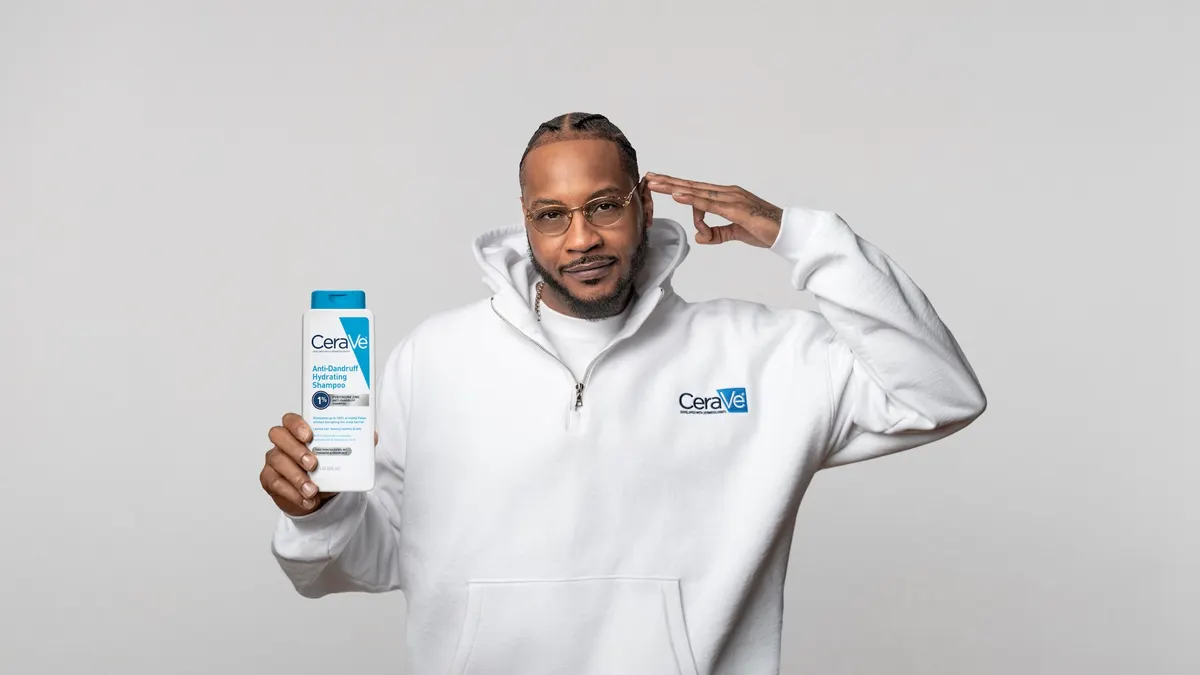
CeraVe is teaming with NBA Hall of Famer Carmelo “Melo” Anthony for a social-first campaign in support of the brand’s anti-dandruff shampoo and conditioner products, per details shared with Marketing Dive. The “Head Coach” campaign references NBA lore around Anthony’s “Hoodie Melo” era, a period beloved by fans when the star player wore a hoodie during off-season practices and other appearances.
“In the NBA, when you’re going to make that shot, the spotlight is directly on that head… that scalp is closer than ever before, which means that your head needs to be quite clean and dandruff-free,” explained Cha Spruce, executive creative director of earned media for North America at Ogilvy New York. “With that insight, we wanted to drive speculation: Was the Hoodie Melo era because he actually had dandruff and was hiding flakes under that hoodie?”
As has become de rigueur for L’Oréal-owned CeraVe, the “Head Coach” campaign was teased with a series of activations intended to generate buzz on social media. Rapper Fat Joe was seen courtside during a playoff game wearing a “Hoodie Melo” graphic hoodie. Oklahoma City Thunder player Isaiah Hartenstein and New York Knicks player Jose Alvarado sported similar hoodies during recent tunnel walks.
For his part, Anthony was featured on street interview series “The People Gallery” in the same sweatshirt. During the video, he appears to brush off dandruff in a tease for the concept behind “Head Coach.” Separately, Anthony also recreated a viral moment from 2016 by wearing a hooded robe to a New York City bodega. The campaign culminated Wednesday with a video announcing Anthony as CeraVe’s “head coach,” with a focus on the hair and scalp. It closes with the star throwing up his “three to the dome” celebration — a hand signal that doubles as a nod to the three essential ceramides in CeraVe.
The “Head Coach” campaign was created by WPP Onefluence, led by Ogilvy PR. In addition to the main video, the effort includes a “Breaking News” online video and a series of content activations that will sustain the campaign into next week, including a segment on Anthony’s “7pm in Brooklyn” podcast.
The campaign is an example of what Spruce calls a “little fires everywhere” philosophy that allows brands to tap into niche audience groups in service of a singular creative idea. While NBA fans are key to CeraVe, so are fashion and music audiences that interact with the league.
“Throughout the campaign, we’ve baked in partnerships with creators that bring up those different intersections so we’re able to go not just deeply into NBA fandom, but also some of these other cultural elements,” Spruce said. “Because attention is so fragmented… we need to be able to capture a few different niche audiences in order to break through.”
Truly social-first
CeraVe last year was named the official skin care and hair care partner of the NBA. Along with experiential and digital activations, the tie-up has included a campaign that featured Kevin Durant and nodded to the NBA star’s reputation for ashy legs.
“We’ve seen the cultural traction of our NBA partnership and our ‘Moisturize Like a Derm’ campaign with Kevin Durant, proving that by engaging authentic voices to address common skin concerns, we can drive meaningful and impactful conversations,” said Esther Garcia, CeraVe’s U.S. general manager, in a statement.
“With Carmelo Anthony as our ‘head coach’ we’re normalizing scalp health discussions and raising awareness for our effective dermatologist-developed solutions,” Garcia added.
Previously, CeraVe ran a “Head of CeraVe” campaign that also centered on anti-dandruff products and featured NBA player Anthony Davis, WNBA player Paige Bueckers and TikTok personality Charli D’Amelio. That campaign was similarly created, produced and executed by WPP Onefluence, led by Ogilvy PR.
Spruce, who joined Ogilvy in October 2024, was previously head of creative strategy at Bodega, Wieden+Kennedy’s social-first creative studio. Social-first tactics are approaching cliché in marketing circles, but not all campaigns billed as such truly embrace social-first principles, Spruce explained.
“Through the work that I aim to do, it’s singularly about inviting our audience in and figuring out how we can speak to them directly,” Spruce said. “The brand does not necessarily take a back seat, but how can we reposition a brand in a way that feels core to the way the consumer behaves and interacts and engages? It’s just not something that typically can start in an organic way without having a really sticky cultural insight.”