Even though Pepsi hasn’t sponsored the Super Bowl Halftime Show since 2022, parent company PepsiCo has maintained a strong presence at the big game, using ads in recent years to launch a revamped Pepsi Zero Sugar, bring back Doritos’ “Crash the Super Bowl” contest and spotlight innovations like Starry and Mountain Dew Baja Blast. That strategy continued this year, with PepsiCo running four ads across three brands — Pepsi Zero Sugar, Lay’s and Poppi — that are central to its growth plans.
PepsiCo saw organic revenue rise 2.1% in Q4 2025 and 1.7% for the full year, per its latest earnings report. Pepsi Zero Sugar saw double-digit net revenue growth and market share gains in 2025, helping to drive volume and growth for the company’s namesake brand. Poppi, the prebiotic soda brand PepsiCo acquired last year, saw estimated retail sales increase more than 45% year over year in 2025, while Lay’s is one of the large global offerings that PepsiCo is restaging as part of its plans to accelerate growth.
At Super Bowl 60, Pepsi Zero Sugar took the brand’s iconic Pepsi Challenge to the next level, Lay’s offered a heartwarming story and Poppi tapped into pop culture with Charli XCX. Ads from Pepsi and Lay’s notched two of the top three spots in the USA Today Ad Meter, while Poppi was the most impactful ad according to data shared by social video intelligence firm Dig.
“The Super Bowl is a once-in-a-year’s moment where you can reach, engage and grab the attention of millions and millions of fans,” said PepsiCo Chief Consumer and Marketing Officer Jane Wakely. “[It’s] that rare occasion where everyone experiences the same thing, so you get lots of talk value.”
The Super Bowl is a major example of how PepsiCo attempts to engage and convert consumers across five dimensions: screen, scroll, search, shop and sense, with “sense” representing experience. While Super Bowl ad campaigns represent screen and scroll, the marketer also delivered sensory experiences around the game without showing up on TV.
“What you didn’t see in a Super Bowl spot this year was Tostitos or Doritos, but we were absolutely there at the Super Bowl, and we’re creating experiences that highlight strategically where we want to take the brands,” Wakely said.
At the Super Bowl, the marketer used a Doritos Loaded Food Truck and Tostitos Cantina activation to move beyond ads. Plus, it owns — but doesn’t pay for — one of the Super Bowl’s most valuable moments: the dumping of Gatorade on the winning coach.
“It recognizes the sweat, the hard work, the authentic performance that team has put in, and our brand is right there,” Wakely said of the big game tradition. “That is an experiential moment for the brand to show up in a way that is authentic to the brand. It’s highly distinctive, and no other brand could do that.”
Pepsi’s challenge
With all of its Super Bowl spots, PepsiCo looks to draw on a brand’s past, put forward an authentic story and create distinctive memory structures for consumers. The big game campaign for Pepsi Zero Sugar, which also called on consumers to reappraise the brand, did all three things.
The brand’s ad, “The Choice,” reimagined the Pepsi Challenge — a part of the brand’s marketing for more than 50 years — by using an animal, the polar bear, that has become synonymous with the Christmas ads of its chief rival, Coke.
“There was a lot of industry debate about whether we were advertising our competitor by using a memory structure that is associated with that brand,” Wakely said. “We were very careful to think through how to make that a call to a very clear Pepsi commercial.”
The marketer in 2025 brought back the Pepsi Challenge with a nationwide taste-test tour focused on Zero Sugar, a brand that Wakely describes as the “future of the category.” Pepsi Zero Sugar saw over 30% sales growth in 2025 and significantly outpaced the broader zero‑sugar cola category, per PepsiCo data.
Similarly, Pepsi has iterated on “Food Deserves Pepsi” and “Pepsi Crashers” platforms that look to drive away-from-home sales. PepsiCo’s away-from-home business delivered mid-single-digit net revenue growth in both Q4 2025 and the full year, per an earnings report.
“Our creative teams and our agency partners really help us create some incredibly attention-grabbing creative, but the strategy goes way beyond that,” Wakely said.
Resetting Lay’s
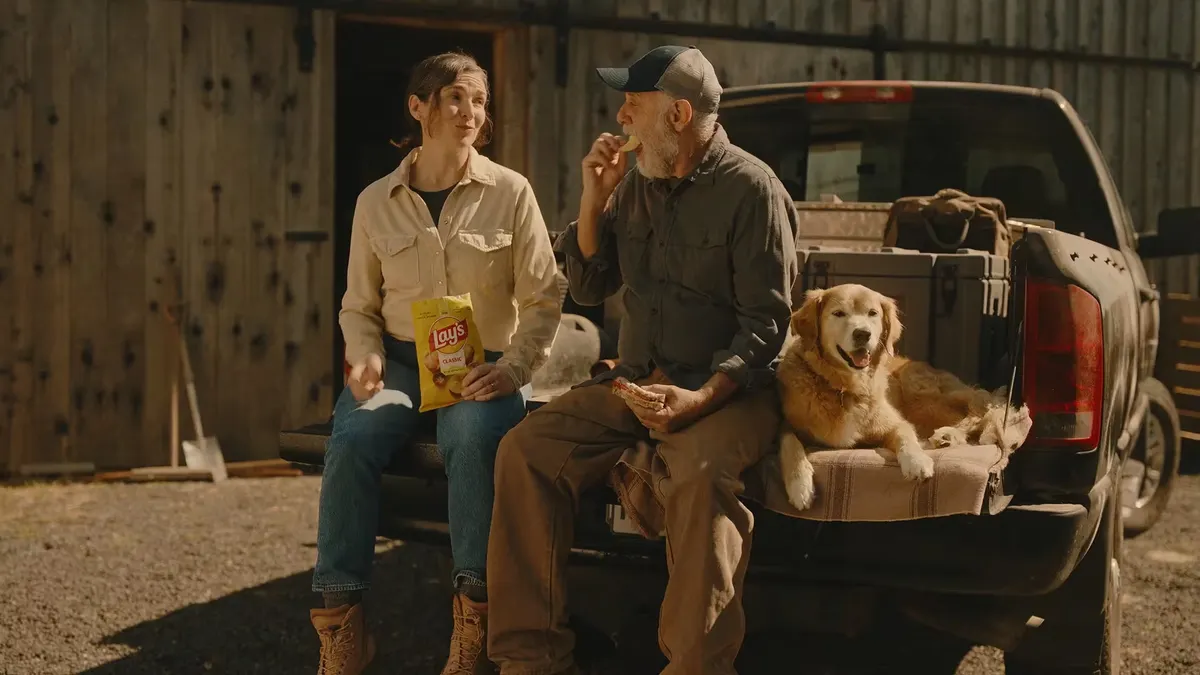
Lay’s expanded on an existing big game strategy for its latest Super Bowl campaign. The new effort built on a well-received Super Bowl 59 ad, “The Little Farmer,” which delivered a simple, heartwarming story about a real farmer.
This year’s effort looked to tap into consumer interest in food while working to address several consumer insights. For instance, more than 40% of U.S. consumers didn’t know Lay’s chips are made from real potatoes, despite the brand working with 55 family farms in the U.S. to source its ingredients, Wakely said.
When bringing its marketing team closer to its farms, the brand realized it could tell an authentic story that grows its distinctiveness in the market while propelling its growth with younger consumers. The result was the touching “Last Harvest” spot that centered on a farmer’s retirement.
“Great creative starts with great strategy that goes beyond your advertising campaign, but instills into your whole brand transformation,” Wakely said.
Building on the way that the Pepsi Zero Sugar campaign called on consumers to try the brand, Lay’s delivered an even stronger call to action in its second Super Bowl spot, which offered 100,000 bags of Lay’s that are scheduled to go from potato to consumers’ doors in 72 hours. Lay’s will continue activating around the Lay’s Challenge in the coming weeks, Wakely said.
Make it Poppi
Poppi’s Super Bowl ad — the brand’s third big game appearance but first under PepsiCo’s ownership — demonstrates how PepsiCo is advertising emerging brands in growing categories like functional beverages. The company is embracing a social-first approach that has proliferated across the CPG category and is typified by the partnership between PepsiCo’s U.S. Beverages division and agency VaynerMedia.
“The Poppi team is incredible. They have built this brand and built it social-first, and they understand their audience. They understand how to position Poppi, how to appeal to the hearts and the minds of Poppi [drinkers] and they are in charge of that brand,” Wakely said of the brand’s “magic recipe.”
Poppi’s 30-second Super Bowl ad enlisted two young stars on social media and pop culture at large: pop star Charli XCX and actor Rachel Sennott. Created with agency Mirimar, the ad was directed by Aidan Zamiri, who also directed “The Moment,” the mockumentary centered around Charli XCX’s “Brat summer” phenomenon that is currently in theaters.
The ad delivers, in its stars’ words, “vibes,” turning a boring classroom into a full-scale dance party complete with motor bikes, flamethrowers and glitter vomit. The campaign is expected to continue, including as part of a push on college campuses.
“I think you’re going to see that [vibes] idea become contagious,” Wakely said. “That is a campaign that is built to be scroll-first, highly discoverable and highly experiential.”