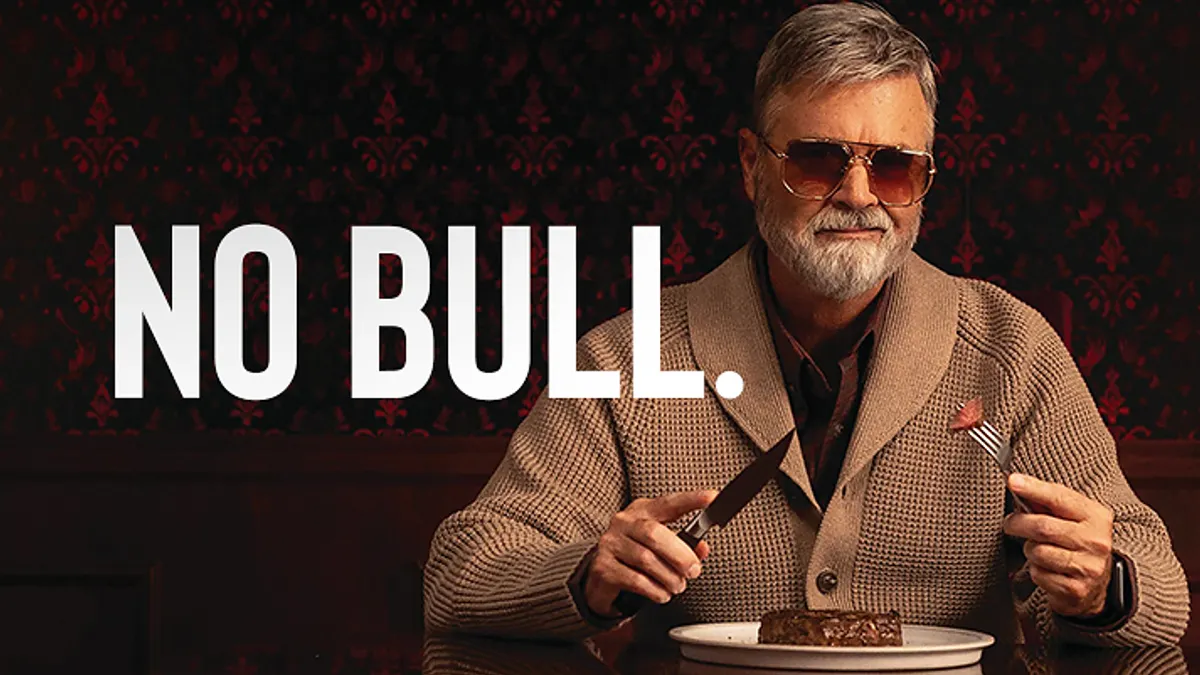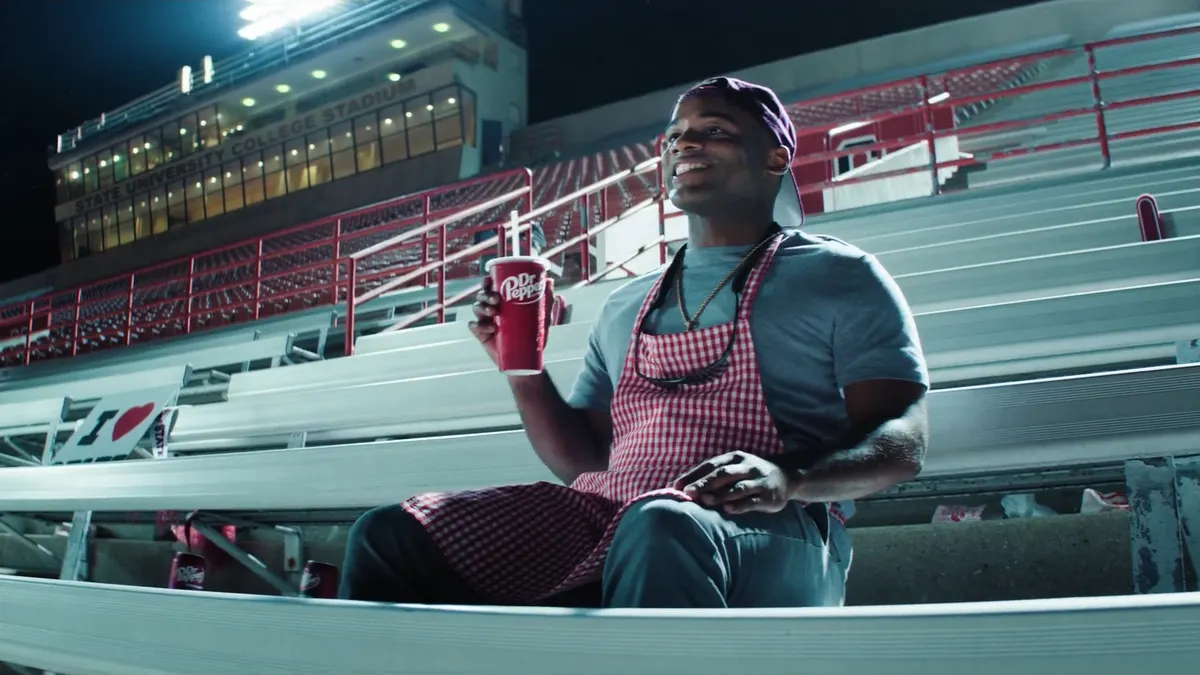
Dr Pepper on Thursday kicked off the ninth season of its college football-themed “Fansville” campaign, according to details shared with Marketing Dive. The program launched with a series of spots that iterate on the parodic concept and feature an “iced” kicker with his leg in a block of ice, a sci-fi take on the transfer portal and a character breaking the fourth wall to say he's been recast with a different actor.
“Consistency doesn't mean sameness,” Derek Dabrowski, senior vice president and head of cold brand marketing at Keurig Dr Pepper, said of the brand’s approach to “Fansville” creative. “We have a recognizable point of view and enough flexibility within college football to stay culturally current.”
KDP has cited “Fansville” as an example of how the company is using artificial intelligence, first- and third-party data and optimized workflows to drive outcomes by using precision targeting and personalization tools. Last year’s iteration included over 2,500 different marketing permutations, driving more than double the sales lift and roughly 30% higher incremental return on ad spend, relative to the national campaign average, KDP CEO Tim Cofer explained at the Deutsche Bank dbAccess Global Consumer Conference in June.
“[“Fansville”] is a super powerful consumer-facing platform, but what makes it a really valuable asset … is it can mobilize an entire business system around a common idea that links to how sodas are bought,” Dabrowski said.
For Dr Pepper, college football is the “gift that keeps on giving,” Dabrowski said, with recent developments including conference realignments, playoff expansions, player movement and the growth of name, image and likeness deals into a multibillion dollar market serving as fodder for “Fansville.” Tropes about fandom, sports and TV shows continue, but storylines, cultural references and fan debates evolve.
“We protect the things that create instant recognizability of the campaign, and then we keep refreshing the things that create relevance,” Dabrowski said.
For instance, this year’s content features a cameo by divisive Louisiana State University head coach Lane Kiffin, who has remained a lightning rod for controversy throughout his career. In one teaser, Kiffin is pulled over by a cop for an “illegal lane change” and rolls up his window in defiance — a move the coach improvised on set.
“[Kiffin] understands that college football is at least as much about entertainment as it is about competition,” Dabrowski said. “What makes people like that awesome is they generate conversation, and that's what we're trying to do as well.”
Personalizing and localizing assets
Additional ads will air throughout the college football season on ESPN, CBS and Fox, along with digital, radio, out-of-home and owned social media channels. As with previous iterations of “Fansville,” the new season was created with agency Deutsch, with additional elements supported by the brand’s integrated agency team.
Along with airing episodic ads during college football games, “Fansville” content and activations will be timed to other cultural moments as they develop during the season. The platform will also feature branded merchandise; a kickoff moment in Bloomington, Indiana; an activation in Norman, Oklahoma, timed to the Red River Rivalry game, and a tuition support contest.
“A lot of folks see the results through broadcast, stunts or whatever we're doing within the college football environment, but there's a whole system that we're galvanizing around that,” Dabrowski said.
KDP is able to better understand signals and triggers around consumer behaviors through media planning and execution with Publicis, collaboration with retail media partners and its internal first-party capabilities and martech stack. Creative by Deutsch goes further in the company’s marketing environment.
“We can keep this [creative] fresh, but continue to get more out of a compounding asset that we've invested in for almost a decade. We can stay efficient and get greater ROI through precision at scale and dynamic creative optimization,” Dabrowski said. “Ten to 20 years ago, this was a [fantasy] that we can actually capitalize and make real now.”
Dr Pepper initially created “Fansville” to celebrate, live alongside and participate in college football fandom — not to interrupt it. The brand was not interested in a logo-slap sponsorship or traditional “spots and dots” advertising. The next step of Fansville and fandom requires the brand to invest in content creators, the de rigueur tactic that is evolving into a media channel.
At launch, “Fansville” will be in 50 different markets with over 200 pieces of content that can be localized to meet consumer needs and adapted to help the brand operate at the speed of culture throughout the season.
“We are trying to understand college football fandom better than any other brand,” Dabrowski said. “Content creators serve almost as much of a role in fueling fandom and showing that we get fandom better than any other brand as the broad-based national linear TV stuff.”