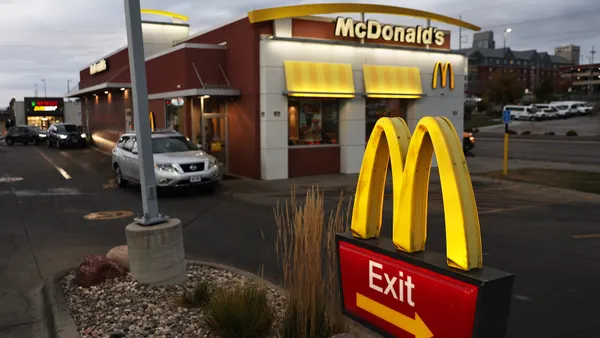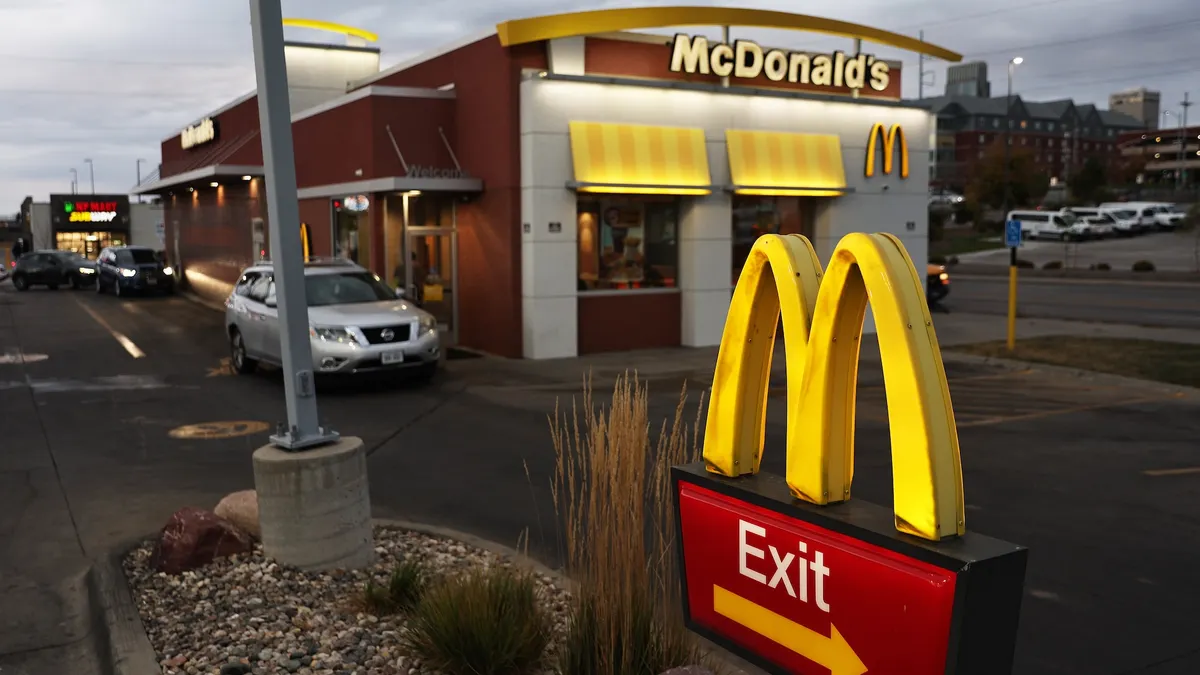
McDonald’s began piloting a media network across 450 company-owned restaurants in the U.S. last month, the Golden Arches owner announced during its investor day presentation on Wednesday. The fast-food giant hopes to build the offering into a billion-dollar business by showing ads from other brands during moments when customers engage with its app, kiosks, menu boards and restaurants.
“Commerce media is one of the fastest-growing areas in advertising and is expected to reach more than $100 billion in the U.S. alone by 2028,” Morgan Flatley, McDonald’s executive vice president and global chief marketing officer, said during the presentation. “It's an opportunity to generate revenue for the system with little in the way of additional cost, no operational complexity and no disruption to our customer experience.”
Plans for McDonald's Media Network surfaced in media reports earlier this week, and the formal announcement was among several marketing developments shared during the company’s first investor day since 2023. The event saw McDonald’s executives dig into a strategic plan that was unveiled in June.
McDonald’s marketing initiatives are part of a consumer-focused pillar of the plan that includes creating brand-led content and co-creating with fans to reach consumers in relevant and personalized ways. Flatley detailed how McDonald’s will leverage fandom for the brand, which she said captures approximately 40% of positive mentions on social media across leading QSR brands — more than its next three competitors combined.
“These fans are the foundation of our new marketing model, which includes engaging them in big global moments and building deeper individual relationships,” Flatley said. “We're evolving exactly how we build our brand to be more efficient and effective at moving culture to support customers making us their first choice.”
Fewer, bigger campaigns
McDonald’s three-pronged marketing approach includes running globally scaled campaigns that can be amplified by fans and creators, helping the brand spend less on paid media. The campaigns will be built on its own intellectual property, making its marketing more distinct and ownable, and will run on a simplified calendar that prioritizes fewer but bigger ideas.
“We're roughly doubling our investment in longer-running baseline-building programs focused on core credentials like our brand, taste and quality, and value, while reducing the number of short-term promotional campaigns,” Flatley said.
Simplifying the marketing calendar was first raised during the company’s Q2 earnings call around the underperformance of the brand’s FIFA campaign. The rapid succession of campaigns around the World Cup, “K-Pop Demon Hunters” and its value menu was cited as a drag on operations.
“As we continue to make the upgrade around the taste and quality of our food and drive consumer awareness of it… that's going to be the gift that keeps on giving,” McDonald’s CEO Chris Kempczinski said during the investor event. “You actually become a little bit less dependent on [whether] you have the right movie property this month or … the right other partnership which creates a little bit of that boom-bust dynamic.”
During the investor event, McDonald’s demonstrated how its new marketing model works by detailing a recent global campaign, the World Menu Heist, that brought beloved local menu items from around the world to other markets. The effort tapped into fan interest to both generate millions of views and thousands of comments across social media and spur incremental guest counts and sales — all by using the brand’s own equity and IP.
Global efficiency
McDonald’s has seen the power of unique brand experiences like the Grimace Shake, Adult Happy Meals and Famous Orders before, but believes such campaigns will be even more powerful in the future as the brand steps up its menu and looks for global efficiencies.
“We worked with around 10 major partners for Menu Heist versus the 40 that would traditionally have been used if each market had to execute locally, reaching greater scale than any market could achieve on its own,” said Manu Steijaert, president of international operated markets.
McDonald’s is also seeking global insights and innovations through a unified mobile platform called Global Mobile App One, or GMA One, that is scheduled to be piloted in France later this year before scaling to other markets by the end of 2028. The offering looks to learn from technologically advanced markets like China that are on the forefront of social commerce and other digital engagement.
Often, a company’s digital experiences are built market by market with different code bases, development plans and capabilities, a process that is slow, expensive and inefficient, explained Dario Baroni, president of McDonald's international developmental licensed markets. McDonald’s used a different approach.
“Over the last three years, we rearchitected our digital foundation from the ground up, unifying ordering, marketing, loyalty and data into one single global backbone,” Baroni said. “The new platform unlocks monthly features across nearly every market, and because this architecture is modular, it is AI ready. It is built for speed, to plug directly into emerging conversational commerce channels without reengineering our core.”