

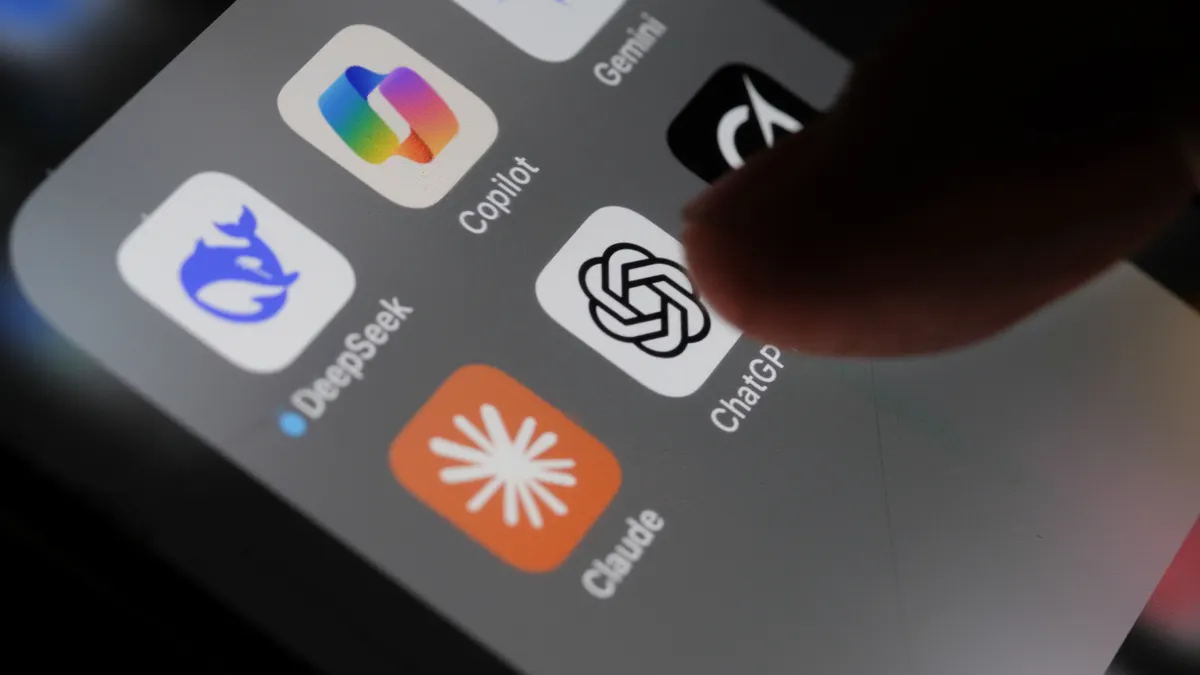
Adopters of artificial intelligence tools like OpenAI’s ChatGPT and Google Gemini are starting to set more of their brand preferences within chatbots. In the grand vision of technology developers, agentic AI will eventually identify relevant products, seek them out online and even shop, all with relatively little direct user input. That poses significant challenges to building and maintaining brand loyalty, according to new findings from the Gale agency.
The AI shift means marketers need to keep a closer ear to the ground with their communities while delivering experiences that have as little friction as possible to avoid putting off fickle customers. Over half, 56%, of surveyed consumers are now comfortable delegating the entirety of their communications with a brand through AI while nearly one-third have instructed an assistant to prioritize certain brands over others.
“That’s pretty alarming,” said Gale CEO Andrew Noel. “They’re saying, ‘I will trust the [large-language model] to be my filter between me and a brand.”
The agency’s report, titled “The Preference Economy,” envisions a world where a growing cohort of AI-savvy consumers architect the entirety of their commercial reality through a reliance on AI, raising existential questions around the role both marketing and loyalty play. Roughly a quarter of respondents indicated they will regularly set brand preferences with AI within the next year, but the potential addressable market for what Gale calls AI-native loyalty could balloon quickly as the technology becomes more ubiquitous.
“You’re looking at 60% to 70%, in the next two to three years, [who] are going to instruct the LLMs to set their preferences, meaning I only want to really talk to these four or five [brands] because I prefer them,” said Noel. “If you’re brand side and you think about the technical implications of that, I think you’ve got a lot to think about.”
Great expectations
The AI disintermediation problem compounds an already volatile market for loyalty, including widespread feelings of indifference. The average consumer is enlisted in four to six loyalty programs, per Gale, but a meaningful chunk do not actively participate, making them “ghost members.” Gale surveyed 3,000 consumers in the U.S. and U.K. for its research.
Millennials and Gen Z represent the most meaningfully engaged loyalty cohorts but are also some of the pickiest. Younger consumers put a premium on seamless experiences and are quick to abandon brands that don’t deliver on this front. Among those aged 25 to 34, 61% dumped a brand for a competitor because of a superior loyalty experience, even though the actual rewards from the competitor’s program were worse.
“The expectations that millennials and Gen Z have, in particular when they interact with brands, is really high,” said Noel.
Gen Z and millennials also happen to be leading the charge on AI adoption, but the AI conundrum isn’t contained to a certain age demographic. Across all respondents to Gale, including non-AI users, 47% trusted AI as a method for starting brand and product research while 16% expressed willingness to act on an AI’s recommendation without further debate. About a quarter of those surveyed were comfortable with AI learning about their brand preferences versus 20% who said the same for cookies and 17% for social media. Privacy concerns were more prevalent with older consumers while 27% of 25 to 34 year olds were not worried about the subject at all.
“[A]mong the youngest consumers surveyed, the most common response wasn’t hesitation or resistance; it was that they simply hadn’t thought about it yet,” the Gale report reads.
Breaking through
The need to break through an increasingly automated world may lead marketers to again double down on first-party data following the cookie deprecation push of the early 2020s. A more direct understanding of customers’ behavioral patterns means brands will be able to better feed AI systems, according to Gale.
“You’ll hear most CMOs today say we sit on a treasure trove of data, but not a lot of insights from it,” said Noel.
Strategies to adapt to the AI economy vary by category — a QSR will require a different approach than a big-box retailer — but Noel pointed to understanding community as a key differentiator. That could entail closer social listening on platforms like the chat app Discord to identify trends bubbling up in a community, or investing more in traditional tactics like surveying shoppers in the aisle for businesses with a large brick-and-mortar footprint.
Harnessing those insights to inform personalization efforts will help maintain brand relevance as control of other aspects of the loyalty pipeline are taken over by AI. Prior Gale studies reveal that nearly 70% of consumers are more likely to join a loyalty program with an active community while 30% feel a stronger connection to a brand due to the social aspects of its loyalty offering.
“You’ve got to be really dialed in on … the community management side of it. How do you really make people feel that they’re known and special to the brand?” said Noel.
At a time when marketing budgets are broadly under pressure due to macroeconomic volatility, and with more consumers trading down, another consideration is maintaining spend on loyalty programs. Too many marketers treat loyalty as a one-off discount program when AI is reinforcing the need for dynamism.
“Just like you would with your media budget, the ongoing investment into the experience, into the mechanics and into the technology often that supports [loyalty] is a line item that I would encourage brands to think hard about more,” said Noel.