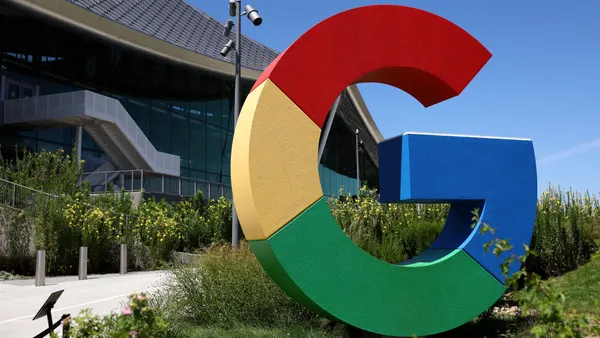


The rate of advertising revenue growth for Google’s key search and YouTube services decelerated in Q3 compared to the year-ago period. While search and YouTube both increased ad revenue by 15% in Q3 2025, those segments posted gains of 12% and 9%, respectively, in Q3 2026, per an earnings statement from parent company Alphabet. Total Google ad revenue was up 10.6% for the period ended Sept. 30.
Search’s haul for the quarter landed at $63.4 billion, still representing Google’s largest piece of business. Executives underscored traction for artificial intelligence-powered offerings like AI Mode that are leading to longer, more involved search behaviors — which, in turn, create more upper-funnel marketing opportunity — and driving up search volume. Query growth reached the fastest level in five years in Q3. AI Mode is in the midst of expanding its ads offering internationally and bringing a multiturn ad format that appears in follow-up queries to the U.S., Google announced around the earnings.
“Just like our shift to mobile over a decade ago, we are focused on building the best search user experience, followed by monetization,” Google CEO Sundar Pichai said on a call discussing the results with investors.
This is the second consecutive quarter when search, Google’s bread and butter, has fallen short of analyst estimates. Shares in Alphabet plunged following the earnings report Wednesday afternoon.
The impact of foreign exchange headwinds and pressures in specific categories, like retail in Asia-Pacific, contributed to the slowdown in search. Some search ad spending also normalized coming off an unusually busy Q2 fueled by the World Cup.
“It's worth noting that the strong growth in AI Mode queries had an impact because of the lower monetization we were seeing in AI Mode,” Chief Business Officer Philipp Schindler said in response to an analyst question about the gap between search activity and revenue.
Google search is facing fresh competitive challenges. OpenAI has quickly built out an ads business for ChatGPT while Meta is ramping up focus on its consumer-facing Muse agent. Google’s agentic offerings include a new Universal Shopping Cart that helps users save products, track promotions and purchase from a number of retailers. Universal Shopping Cart started rolling out in the U.S. earlier this month to capitalize on the holiday season.
“I'm excited about agents, and I would view it as a new frontier, which brings in a new set of use cases to search,” said Pichai.
Google stands among a fleet of tech companies that are facing greater pressure to justify their astronomical investments in AI. Capital expenditures hit $51.4 billion in Q3 while negative free cash flow stood at $9.1 billion. The company said capital expenditures, which are expected to land between $195 billion and $205 billion this year, will again jump significantly in 2027.