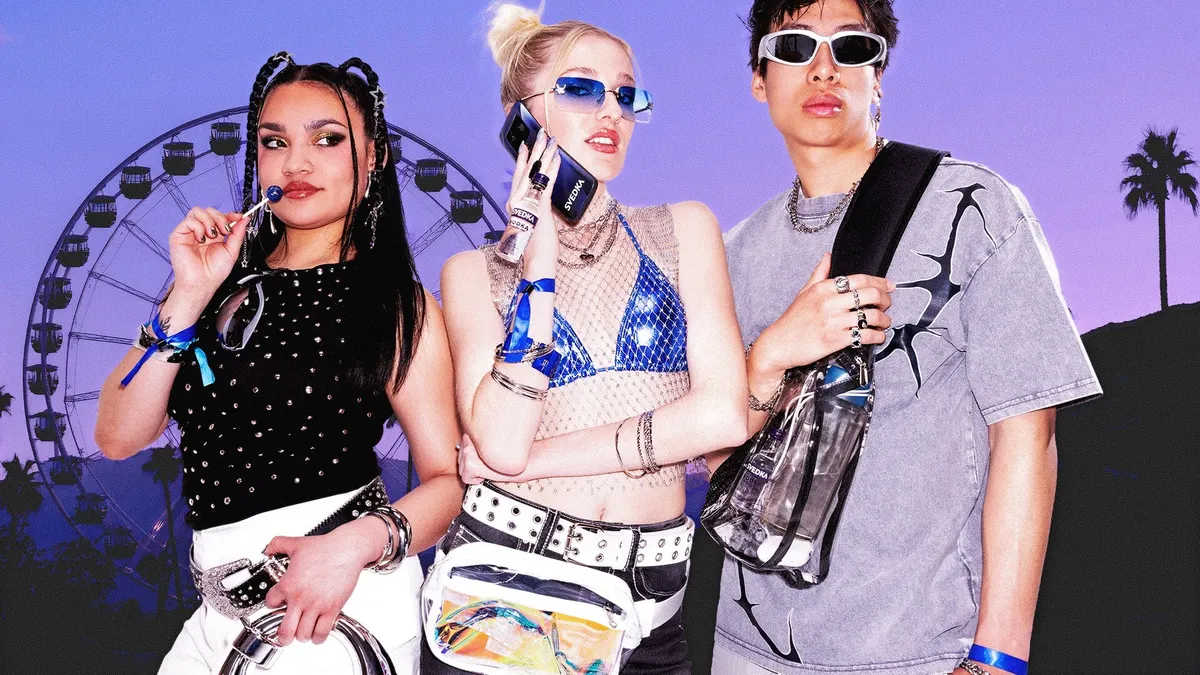
Svedka is updating an old marketing concept after a sale to Sazerac last year and as part of the brand’s efforts to reintroduce itself to modern consumers. In the mid-2000s, the vodka maker made a mark by positioning itself as the “No. 1 vodka of 2033,” using futuristic hues and a sleek Fembot mascot in its marketing.
Svedka recently revived the idea, albeit on an altered timeline. Now calling itself the “No. 1 vodka of 2055,” the spirits marketer is going back to the future by resurrecting a recognizable brand asset and an underlying platform that encourages human connection.
The 2055 concept builds on a campaign from last August that offered to pay consumers’ bar tabs if they promised to put their phones away and socialize in real life. It also saw the return of Fembot following a 12-year hiatus. Svedka then made its Super Bowl debut in February with a commercial that was created using artificial intelligence and similarly oriented around the robotic character. More recently, the brand released a Y2K-inspired flip phone that limited communications to calls and texts timed to music festival season.
These efforts come as Sazerac looks to expand its spirit portfolio. At the end of April, the company took a minority stake in 818 Tequila, the brand founded by Kendall Jenner. Marketing Dive spoke with David Binder, senior brand director for Svedka at Sazerac, about the brand’s strategy and what it learned from its first Super Bowl appearance.
This interview has been edited for clarity and brevity.
MARKETING DIVE: How would you describe Svedka's current marketing approach, and how does it differ from what the brand has done in the past?
DAVID BINDER: I think it is important to look back at what was done in the past as we consider how that differs from what we’re doing in the present. Svedka was a brand that was launched with purpose and intent, and it grew quickly. And there was a lot of traction behind the iconic Fembot brand asset.
There’s nostalgia in many realms today, and marketing is no different, especially if you’re trying to tap into the consumer zeitgeist. we brought back the Fembot last August with the somewhat ironic purpose of using technology to remind consumers of something simple: The best moments happen when you’re present with the people around you.
When the Fembot was introduced in 2005, the idea of a dancing robot future seemed a ways off. In 2026, we live in a time where we regularly see humanoid robots dancing on YouTube. How does the Fembot fit into that new reality?
When the robot initially launched, the future was a fun idea. Dreaming of what technology might look like, flying cars and walking robots. That was a dream that seemed very far off. We [Sazerac] didn’t own the brand then, and I wasn’t in charge of the creative, but she played a role in tying it to the future.
But the role she plays is a bit different now because people are sometimes uncomfortable with where technology is now. AI is everywhere. Tech is everywhere. It’s moving faster than we can understand. I think that tension goes beyond just AI; it’s about technology and the future in general. The future feels a bit less whimsical these days and a bit scarier.
And so that’s where we see her role shifting. Consumers at large, and particularly younger consumers, are looking backward to lean into nostalgia. We feel like she’s got a fun way to do that, where she can still keep the retrofuturistic, nostalgic vibe, but without the “We’re coming to take over the Earth” vibe. It’s more, “I’ve been to the future. I’ve seen it, and humans are the answer.”
Let’s talk about the Super Bowl. There was a lot of press about the AI-generated ad, which was met with skepticism, if not backlash. How did that come about?
We’d already had to use AI to recreate [Fembot] and build her into a movable model. Obviously, anything you do in the Super Bowl is going to be hypercriticized. But it’s not foreign to this brand’s ideology. We’re using a robot. We’re saying we're the No. 1 brand of 2055. In a meta way, it makes sense that we would take that first step and use AI to push into the future.
I do want to clarify that we are not making a binary choice between humans and robots. [AI] is a tool. It’s an exciting tool, and it’s one that’s expanding everybody’s minds about what we can dream up. But there was very much a talented and diverse creative team of humans leading the charge, writing the script, dictating what should happen here and there, in the same way that you do any other production. It was very, very, very human-led, human-ideated, human-driven.
What did you learn from that experience?
It confirmed a lot of what we expected, which is we know that AI is a polarizing topic. Coca-Cola got some strong opinions when they used AI in a commercial. But for advertising to break through in today’s incredibly fragmented and increasingly competitive world, it’s got to be bold. It’s got to spark a conversation. So I would say the debate and the dialogue about how we did it means that the creative did what we wanted to do.
For what it’s worth, we saw a major sales increase during that Super Bowl season. So ultimately, we were super happy with the results.
What does it mean to you that both Svedka and Heineken, which generally exist in the same consumer space, are taking similar approaches to technology [the beer brand previously released its own take on a “dumb phone”]?
In marketing, for a consumer insight to be true, it ought to be broad and simple, which means it’s totally understandable that multiple brands might stumble upon a [similar] insight. But as to why that’s the insight, I’ll give you an anecdote: My wife’s little sister has been living with us while going to college over the last few years. She’s in her early 20s, and it baffled me to see the things that she was fascinated by. She asked me to show her how to wind film in a film camera. It’s like the over-connectedness is almost overstimulating, and, as a result, you’re seeing a lot of Gen Z revert back to film cameras, dumb phones, even retro fashion.
We want to tap into what Gen Z are yearning for with that nostalgia, but that’s not a trend that’s isolated to them. Some older millennials are also really drawn to simpler times. Bringing back an asset that reminds you of what you were doing circa Y2K is absolutely part of the strategy and intentional.